 FileScanner.online
 URLScanner.online
Why Security Professionals Are Searching for a VirusTotal Alternative
VirusTotal has been the industry standard for file and URL scanning since 2004. Acquired by Google in 2012, the platform aggregates results from over 70 antivirus engines and provides a single verdict on whether a file or URL is malicious. For two decades, it has been the primary tool security analysts reach for when triaging a suspicious sample.
However, the cybersecurity landscape of 2026 demands more than simple multi-engine aggregation. Security professionals, incident responders, and privacy-conscious users are increasingly searching for a VirusTotal alternative that addresses specific challenges: the public exposure of uploaded files, the manual effort required for false-positive triage, restrictive file size limits, and the lack of AI-powered contextual summaries.
This is where newer platforms like FileScanner.online and URLScanner.online—built by the Aprensec cybersecurity team—offer a different approach. Rather than aggregating dozens of engines, they combine deep structural analysis, real-time threat intelligence, YARA rule matching, AI-driven detection summaries, and strictly private scanning into a unified workflow mapping more closely to modern incident response needs.

Limitations of the Public Aggregation Model
The most discussed limitation of VirusTotal as a security tool is its public-by-default model. Every file uploaded to the free tier is shared with the global security community—including the 70+ antivirus vendors, researchers, and potentially the threat actors themselves. Uploading a suspicious file during an active incident response can alert an adversary that their malware has been discovered, prompting them to rotate infrastructure and evade further detection.
For enterprises handling sensitive data, this creates a significant operational risk. Uploading a potential data exfiltration payload that contains fragments of proprietary code or customer PII to a public repository turns a standard security investigation into a potential data exposure event. While VirusTotal Enterprise offers private scanning, its pricing is designed for large-scale operations rather than independent analysts or SMEs.
A secondary challenge is the noise generated by false positives. VirusTotal aggregates 70+ engine verdicts but leaves the synthesis to the human analyst. A benign heuristic pattern might trigger 3 out of 70 engines, requiring manual investigation to determine whether the detections are legitimate threats or simply scanner noise. Without an AI layer to contextualize why specific engines flagged the file, triage times remain high.
Finally, while VirusTotal provides extensive vendor verdicts, it offers limited native structural analysis. To get a complete VirusTotal alternative workflow in 2026, analysts require built-in PE/ELF header parsing, YARA rule matching across multiple threat categories, and AI-generated summary reports that translate raw indicators into readable intelligence.
| Constraint | VirusTotal (Free Tier) | Impact on Security Operations |
|---|---|---|
| Scan Privacy | Public by default — files shared globally | Adversaries may be alerted during IR; sensitive data leakage risk |
| False-Positive Triage | Raw engine counts without synthesis | Analysts spend significant time validating benign heuristic detections |
| AI-Powered Summaries | Not available in free tier | Requires high technical expertise to interpret complex or conflicting results |
| File Size Limit | 650 MB maximum | Large binaries, disk images, and massive archives cannot be scanned directly |
| Compliance Reporting | No native PDF export | Requires manual documentation for incident reports |
| Structural Analysis | Basic metadata oriented | Deep binary parsing requires transitioning to sandbox or local tools |
filescanner.online
Scan Any File — Privately.
Deep binary analysis, YARA rules, AI summary, and PDF reports. Up to 2 GB. No account required.
FileScanner.online: A Private-First Approach to File Analysis
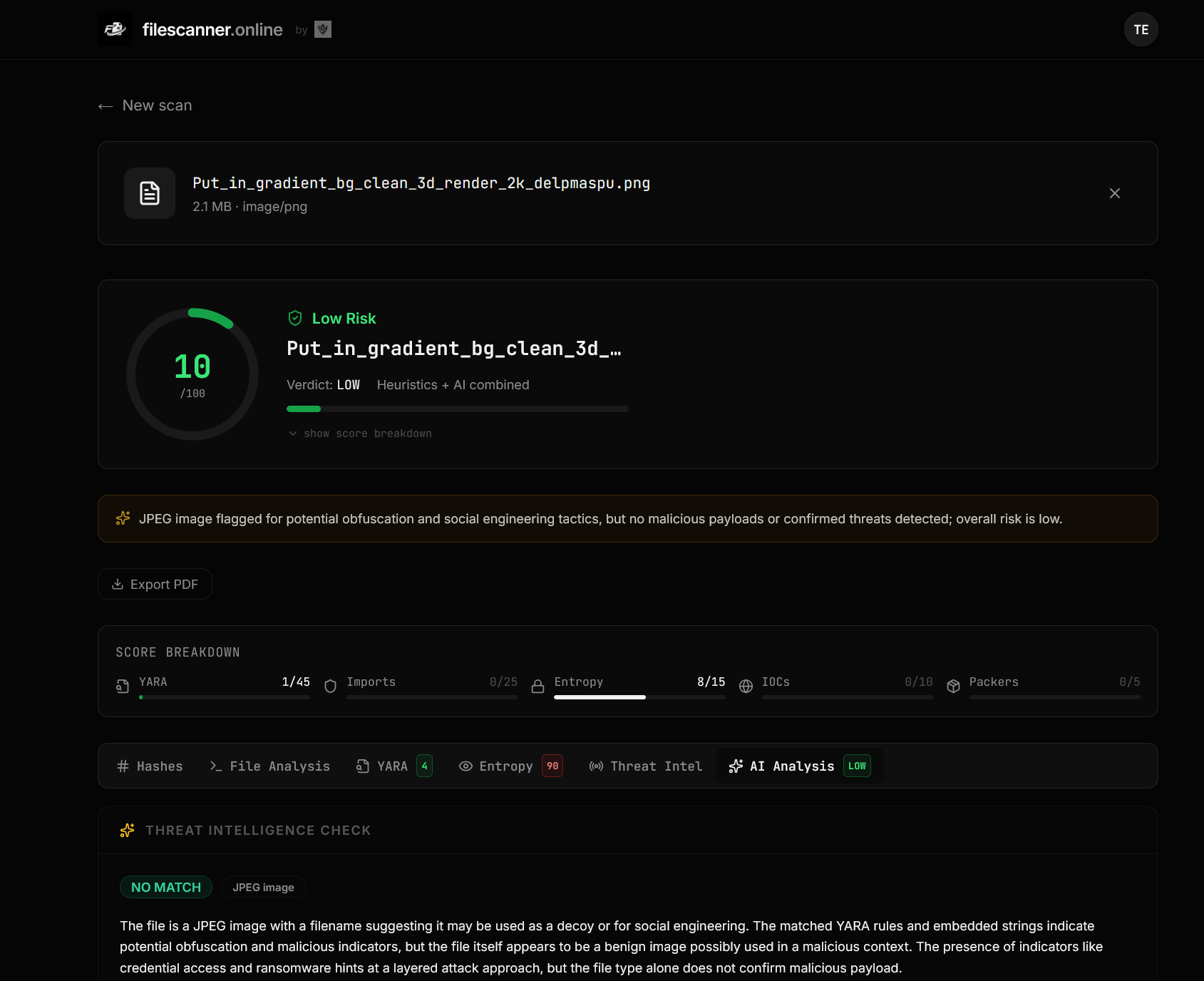
FileScanner.online represents a structural shift in how automated file analysis is performed. Rather than aggregating third-party engine verdicts, it performs direct foundational analysis of the uploaded file—parsing binary headers, matching against specifically curated YARA rules, querying real-time threat intelligence feeds, and synthesizing the findings through a local AI engine that produces a readable summary report.
A defining feature of this workflow is that every scan on FileScanner.online is strictly private. Files are never shared with third-party vendors, indexed in public databases, or accessible to other researchers. For incident responders needing a VirusTotal alternative that won't tip off an adversary, or for organizations bound by strict data privacy regulations, this private-by-default architecture is critical.
The platform also increases the standard file upload limit to 2 GB—more than triple VirusTotal's 650 MB cap. This accommodates the analysis of large firmware images, memory dumps, heavy installers, and compressed archives that are increasingly common in modern attack vectors.
FileScanner.online Technical Capabilities
Hash Verification — FileScanner.online computes MD5, SHA-1, and SHA-256 checksums, cross-referencing them against known malware databases for instant identification of previously cataloged threats before deeper inspection begins.
Binary Analysis — The platform executes comprehensive PE (Portable Executable) and ELF (Executable and Linkable Format) binary parsing. It extracts section headers, import/export tables, resource directories, and compilation timestamps. The system automatically flags structural anomalies, such as packed sections with high entropy or mismatched timestamps.
YARA Scanning — Files are matched against 17 curated YARA rules spanning 13 distinct categories. By relying on YARA rules designed to detect specific byte patterns, strings, and structural characteristics, the system can identify malware families and hacking tools that might evade pure signature-based antivirus engines.
Malware Detection via API Patterns — The platform identifies over 70 suspicious API calls and import patterns. This includes process injection APIs (like VirtualAllocEx), credential harvesting functions, anti-debugging techniques, and common network communication APIs used for C2 beaconing.
Contextual Threat Intelligence — File hashes are queried against real-time threat intelligence feeds, including CIRCL, Team Cymru's Malware Hash Registry (MHR), and Abuse.ch's ThreatFox. This provides immediate context regarding whether a file is part of an active campaign.
AI Analysis and Synthesis — The core differentiator of FileScanner.online as a VirusTotal alternative is its AI synthesis layer. After technical modules complete their scans, an AI model evaluates the combined findings. It explains the detections, identifies likely false positives by correlating structural properties with the flagged behaviors, and generates a downloadable PDF report suitable for compliance or executive briefing.
| Feature | FileScanner.online | VirusTotal (Free Tier) |
|---|---|---|
| Hash Verification | MD5/SHA matched with structured threat intel | MD5/SHA matched with community comments and 70+ engines |
| Binary Parsing | Deep PE/ELF header analysis with anomaly detection | Basic metadata and structural info |
| YARA Rules | 17 specific rules across 13 threat categories | Community YARA rules (limited in free tier) |
| Behavioral Indicators | 70+ malicious API/import pattern detections | Behavioral analysis via sandbox execution |
| Threat Intelligence | CIRCL, Cymru MHR, ThreatFox integration | Aggregation of vendor verdicts |
| AI Analysis | AI-driven false-positive detection and synthesis | Not available in free tier |
| Reporting | Exportable PDF summary reports | Raw data view; no native PDF export |
| Max File Size | Up to 2 GB | 650 MB |
| Privacy Model | Strictly private (files never shared) | Public by default (files shared with community) |
urlscanner.online
Scan Any URL — In Under 2 Seconds.
8 parallel security modules: malware, SSL, DNS, phishing, WHOIS, headers, screenshots, and AI scoring. 100% private.
URLScanner.online: A Focused Alternative for Link Analysis
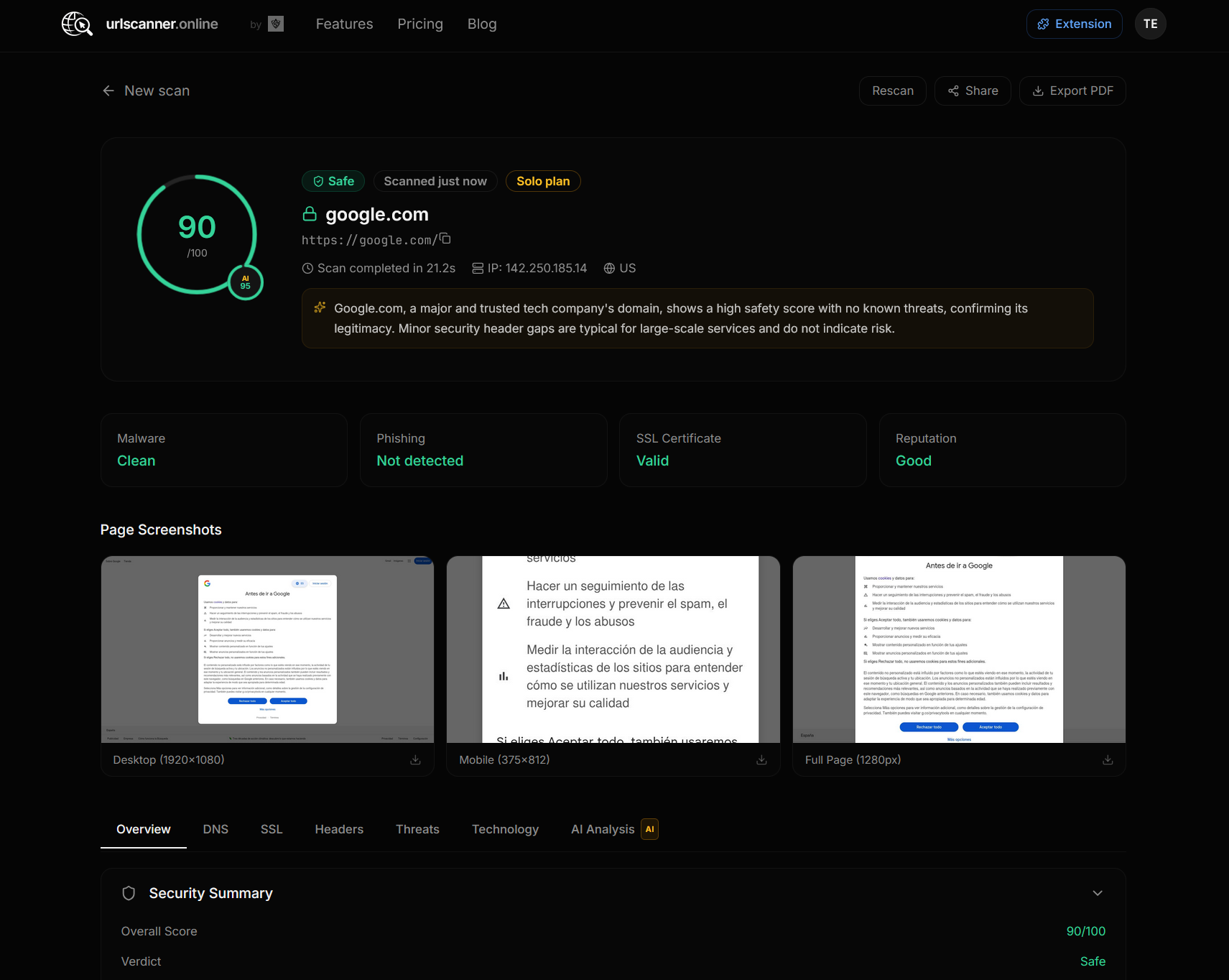
While VirusTotal provides valuable URL scanning by aggregating engine verdicts, URLScanner.online takes a specialized approach to real-time link analysis. It executes 8 parallel security checks, each targeting a different web-based attack vector, and uses AI to synthesize a final safety verdict.
Similar to its file scanning counterpart, every URL scan on URLScanner.online is private. Unfurling a suspected phishing link on a public aggregator can inadvertently validate the target's email address to the attacker (if tracking tokens are included in the URL) or expose internal corporate portals. The private scanning model ensures investigations remain confidential.
Operating with an average scan time of under 2 seconds, the platform offers 5 free scans per day without requiring an account. The real-time terminal output provides visibility into exactly which checks are being performed, adding transparency to the analysis process.
The 8 URL Security Modules
Database Correlation — URLs are scanned simultaneously against four independent threat databases: URLhaus, Spamhaus, SURBL, and Google Safe Browsing to identify known malware distribution sites and C2 endpoints.
SSL Certificate Analysis — The system inspects the full SSL/TLS chain, checking TLS protocol versions, HSTS validation, cipher suites, and certificate expiry to identify insecure or anomalous encryption setups common in phishing infrastructure.
DNS Infrastructure — Full DNS enumeration (A, AAAA, MX, TXT, NS, SOA, CAA) reveals the hosting provider, mail server configurations, and domain authentication policies, providing critical context about the domain's legitimacy.
Phishing Detection Engine — A multi-layered analysis combines domain age verification, SSL validation, and behavioral checks to flag newly registered domains impersonating trusted brands.
WHOIS Domain Analysis — Comprehensive registration data is retrieved. Because a significant percentage of malicious domains are used within days of registration, newly registered domains are automatically assigned a higher risk factor.
Security Score Synthesis — Results are compiled into a weighted security score from 0 to 100 based on the aggregated findings, offering a clear, unambiguous verdict.
HTTP Header Inspection — Critical security headers (HSTS, CSP, X-Frame-Options, X-Content-Type-Options, CORS) are evaluated to ensure basic web security standards are met.
Visual Previews — The scanner renders safe, isolated screenshots of the website across desktop, tablet, and mobile viewports. This allows analysts to visually verify the page content without triggering drive-by downloads or exposing their local environment.
| Module | URLScanner.online | VirusTotal URL Scan |
|---|---|---|
| Databases | URLhaus, Spamhaus, SURBL, Google Safe Browsing | 70+ engines |
| SSL/TLS | Full chain, cipher suites, HSTS, protocol versions | Basic certificate info |
| DNS Data | A, AAAA, MX, TXT, NS, SOA, CAA enumeration | Basic DNS resolution |
| Phishing Intel | Domain age, registration data, behavioral checks | Engine-based detection |
| WHOIS | Full registration data with risk scoring | Basic WHOIS data |
| Verdict | Weighted 0-100 safety score | Detection ratio (e.g., 3/70) |
| Headers | HSTS, CSP, X-Frame-Options, CORS analysis | Not analyzed |
| Preview | Multi-viewport screenshots | Standard screenshot available |
| Synthesis | AI-generated summary and PDF export | Not available in free tier |
| Privacy | Strictly private | Public by default |
Why Operational Privacy Matters
The decision between using a public aggregator and a private VirusTotal alternative often comes down to operational security (OpSec). In modern incident response, submitting a file or URL to an analysis platform is a strategic decision.
Consider an active breach scenario: An analyst discovers an unknown executable on a compromised server. Submitting that file to a public platform immediately distributes the binary to the global security community. Threat actors actively monitor these feeds for their own malware hashes to determine if their campaign has been discovered. The moment they realize they are burned, they can rotate their infrastructure, complicating the investigation. A private scanning environment prevents this early warning system.
Similarly, consider data privacy. A suspicious email attachment might contain malicious macros, but it might also contain sensitive business documents or employee information. Uploading it to a public repository for scanning creates a potential data exposure event. Tools like FileScanner.online ensure that the analysis occurs in an isolated, confidential environment.
filescanner.online
Scan Any File — Privately.
Deep binary analysis, YARA rules, AI summary, and PDF reports. Up to 2 GB. No account required.
The Role of AI in Threat Analysis
One of the functional gaps in legacy aggregation models is the burden of interpretation. A file flagged by 3 out of 70 engines requires human intervention to determine if the detections are accurate or if they are false positives triggered by benign heuristics.
Integrating AI at the end of the technical analysis pipeline shifts this burden. For file scans, an AI model can look at the specific YARA rule matches, the API detections, and the structural anomalies, and provide a clear explanation: "This file is flagged because it uses a packer common to malware, but the API calls are standard for a compiled Python script—likely a false positive."
By providing these contextual summaries—and making them exportable in a standard PDF format—platforms like FileScanner.online and URLScanner.online reduce the manual triage workload for analysts and provide clear documentation for compliance and reporting requirements.
Conclusion: The Evolution of Malware Scanning
VirusTotal remains an incredible tool for the global security community, democratizing threat intelligence and providing unmatched visibility into broad malware trends. However, for specific workflows—particularly those where data privacy is paramount, where large files require deep structural analysis, or where AI synthesis can accelerate triage—a dedicated, private VirusTotal alternative is often required.
FileScanner.online and URLScanner.online provide a complementary approach. By focusing on private execution, deep structural parsing, and AI-driven contextual explanations, they offer security professionals and everyday users a powerful toolkit for conducting safe, objective threat analysis in 2026. Whether you are investigating an incident, verifying a suspicious link, or analyzing a 2 GB memory dump, these tools provide the necessary depth without compromising operational security.
urlscanner.online
Scan Any URL — In Under 2 Seconds.
8 parallel security modules: malware, SSL, DNS, phishing, WHOIS, headers, screenshots, and AI scoring. 100% private.