
 FileScanner.online
 URLScanner.online
Download the full PDF report
Get the complete analysis with all citations, charts, and technical appendices. Enter your email below to receive the download link.
The Technological Collapse of Forensic Detection
The cybersecurity landscape of 2026 represents a definitive rupture in the historical paradigm of digital trust. For decades, the security community operated under the assumption that "detection" was a scalable defense — that with enough data and sufficiently advanced algorithms, the synthetic could always be distinguished from the authentic. That assumption is now obsolete.
The rapid convergence of Generative Adversarial Networks (GANs), high-fidelity diffusion models, and multimodal transformer architectures has closed the gap between real and synthetic. The volume of deepfake content is experiencing a projected 900% annual growth, reaching an estimated eight million files in 2025. High-quality video deepfakes successfully fool human observers 75.5% of the time, making "seeing is believing" a dangerous relic of the pre-AI era.
Early deepfakes relied on visible artifacts: irregular eye-blinking, mismatched lighting, or "ghosting" around the jawline. By 2026, these flaws have been eliminated through frame-consistent video diffusion and advanced latent space modeling. The GAN's generator has reached such sophistication that the probability of a discriminator making a correct classification approaches 0.5 — the threshold of pure randomness. Security Awareness Training that instructs employees to look for "pixel glitches" is effectively training them to fail.
| Metric | 2023 Performance | 2026 Performance | Impact |
|---|---|---|---|
| Audio Sample Requirement | 1-2 minutes | <3 seconds | Rapid voice cloning from social media |
| Video Latency | Non-real-time | <150ms | Real-time conference call impersonation |
| Micro-expression Accuracy | Uncanny/Static | Anatomically Correct | Bypasses traditional liveness checks |
| Cost per Incident | High (Hollywood VFX) | <$1.00 (Open Source) | Scalable, industrialized fraud |
Case Study: The Arup Breach — A $25.6M Multi-Channel Failure
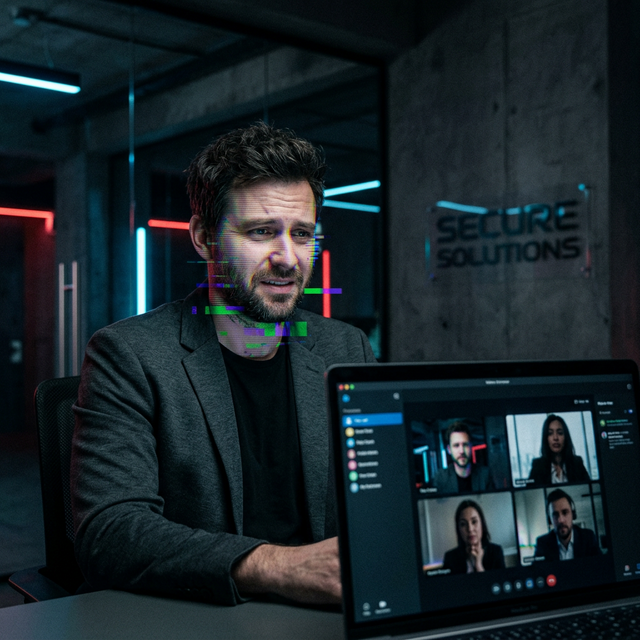
The most significant validation of the "detection is dead" thesis is the 2024 attack on multinational engineering firm Arup. A finance employee in the Hong Kong office joined what appeared to be a routine video conference call featuring the company's CFO and several colleagues. Every participant on the call — save for the victim — was a real-time deepfake synthesized from publicly available footage.
The employee authorized 15 wire transfers totaling $25.6 million USD based on the "authority" established by the visual and auditory authenticity of the call. The fraud was not discovered until a subsequent follow-up with actual headquarters revealed that no such meeting had occurred.
This incident exposes three critical vulnerabilities: The Authority Exploit — attackers utilized the psychological weight of senior leadership to bypass standard skepticism. The Liveness Illusion — traditional "liveness" prompts like asking a participant to turn their head are now easily satisfied by real-time face-mapping software. The Single-Channel Trap — the entire $25.6 million transaction relied on a single communication medium without any external verification.
Reality Poisoning and Organizational Paralysis
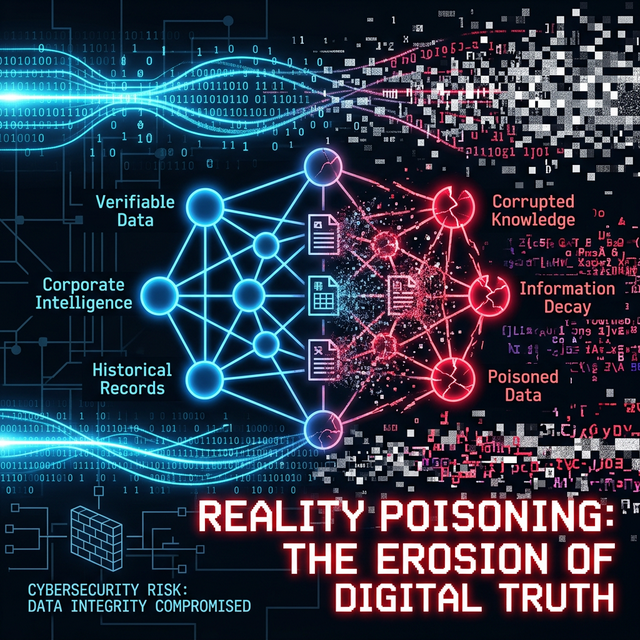
Beyond immediate financial fraud, deepfakes create a more systemic threat: "Reality Poisoning." This phenomenon occurs as the boundary between historical fact and machine-inferred plausibility vanishes. As organizations increasingly rely on AI to summarize internal knowledge, route customer requests, and conduct analytics, the information environment becomes saturated with synthetic content — often called "model exhaust" — that is treated as ground truth simply because of its structured authority.
Reality poisoning triggers a corrosive perception that digital evidence can no longer be trusted, leading to decision-making paralysis. When a CEO cannot be certain that a video message from a board member is authentic, or when an analyst cannot trust the integrity of a dataset, the marginal ROI of digital transformation begins to decay.
The "Liar's Dividend" is another consequence: genuine evidence is dismissed as "fake" by bad actors, eroding accountability in corporate governance. "Synthetic Sludge" makes search results and analytics grow noisier and less reliable, threatening the collapse of SEO and digital marketing ROI. And employees begin to fear retribution for questioning "leadership" deepfakes, increasing turnover and breaking down communication culture.
The Zero Trust Human Protocol
To counter the collapse of visual and auditory trust, organizations must implement a "Zero Trust Human Protocol." This framework shifts the security focus from the content of a message to the channel of verification. Zero Trust, traditionally applied to network architecture, is now being adapted for human interaction: every request involving funds, credentials, or sensitive data must be assumed fraudulent until verified through a separate, pre-established communication channel.
Out-of-Band (OOB) Verification is the single most effective defense against deepfakes. It requires using a communication channel completely independent of the one used for the initial request. If a request comes via video call, it must be verified via a callback to a known, registered mobile number.
Analog "Challenge-Response" Systems provide surprisingly effective low-tech solutions: "safe words" or pre-arranged verification phrases that are department-specific, rotating, and stored in secure offline or encrypted environments. Process Over Persuasion means security training moves away from "gut feeling" toward "workflow hardening." Employees are taught that skipping the verification process is the only "error," regardless of how authentic the requester appears.
The Strategy of "Prudent Friction"
Modern identity verification (IDV) is shifting toward what Gartner calls "KYX" (Know Your Experience), replacing one-time KYC checks with persistent, continuous assurance. This involves injecting "prudent friction" into high-risk workflows — for example, any change to vendor bank details triggers a mandatory 24-48 hour waiting period and a multi-person approval workflow.
The market is no longer searching for a "detection tool" but for a "verification playbook" that can be operationalized across finance, HR, and IT departments. A successful playbook must dismantle the silos between fraud, onboarding, and transaction teams, creating a unified "truth layer."
| Action | Technical Mechanism | Strategic Goal |
|---|---|---|
| Secure the Camera Pipe | Injection attack detection for virtual cameras | Prevent feeding deepfakes into video streams |
| Dual-Control Mandates | Multi-factor approval for wire transfers >$10,000 | Eliminate single points of human failure |
| Out-of-Band Callbacks | Verification via pre-registered phone directory | Bypass the attacker's controlled communication lane |
| Phishing-Resistant MFA | Hardware keys (FIDO2) instead of SMS/Push | Prevent credential theft and MFA fatigue attacks |
Simulation-Based Training: Building the "Pause-Verify" Reflex
Detection is a passive act; verification is a skill that must be practiced. Aprensec's approach to cybersecurity training reflects the reality of 2026 by moving beyond compliance-based videos toward continuous, simulation-driven "habit-building." By placing employees in simulated deepfake scenarios — such as an urgent voice-clone request for a password reset — the training builds the "pause-verify" reflex.
Research indicates that unchecked AI phishing can drive click rates as high as 54%, but repeated exposure to high-fidelity simulations can reduce this rate to 4.1%. Aprensec's methodology focuses on three outcomes: Normalization of the Pause — making it standard procedure to halt "urgent" requests for five minutes to perform OOB verification. Cognitive Defense Strengthening — teaching employees how attackers use "myth-direction" and "A/B-tested sycophancy" to manufacture legitimacy. Reporting and Containment — rewarding employees for early reporting of "near-misses," which allows fast containment before a breach escalates.
The playbook also requires a "Culture of Courage," where employees are praised for challenging a deepfake CEO. Organizations like Aprensec specialize in creating the "practice arena" where these habits are forged through hyper-realistic simulations.
The Regulatory Landscape and Content Provenance
The industry is shifting focus from "Is it fake?" to "Is it real?" through adoption of content credentials and digital watermarking. Cryptographic watermarking is now mandated by the EU AI Act, requiring clear labeling of deepfakes and implementation of transparency controls. Device-level capture verification signs video or audio at the point of capture, ensuring it has not been synthetically altered. And blockchain-based media tracking allows public figures to cryptographically sign all official communications.
Regulators are increasingly holding organizations accountable for failing to prevent deepfake-enabled fraud. FinCEN has issued formal alerts requiring institutions to tag suspicious activity reports (SARs) with specific deepfake identifiers. The NACHA 2026 rules mandate "commercially reasonable" fraud detection for web debits, signaling that out-of-band verification is moving from recommendation to regulatory expectation.
| Framework | 2026 Requirement | Impact |
|---|---|---|
| EU AI Act | Mandatory labeling of AI-generated content | Increased media transparency |
| FinCEN Deepfake Alert | Tagging SARs for synthetic identity fraud | Enhanced financial reporting burdens |
| NACHA 2026 Rules | Commercially reasonable fraud detection | Mandatory verification for online transactions |
| State Privacy Laws (IN, RI) | Enhanced due diligence for high-risk data | Rigorous auditing of ad-tech and AI data flows |
Securing the Human Interface in a Post-Truth World
The explosion of deepfake technology in 2026 has rendered the eyes and ears of even the most diligent employees unreliable. As the Arup breach and the subsequent $12.5 billion in fraud losses demonstrate, "detection" is a failed strategy in the face of an AI that can perfectly simulate the humans we trust most.
The transition to a "Zero Trust Human Protocol" — where every high-stakes interaction is verified via a secondary, independent communication channel — is the only viable path forward. Reality poisoning represents more than a cybersecurity threat; it is a fundamental challenge to the integrity of corporate decision-making.
By adopting a "Verification Playbook" and utilizing the "practice arena" provided by Aprensec's simulations, organizations can move from a posture of vulnerability to one of resilience. In an era where seeing is no longer believing, trust must be built not on the appearance of authenticity, but on the rigor of out-of-band verification. The cost of inaction is no longer just a financial risk; it is the potential collapse of the trust-based workflows that sustain modern enterprise.
Download the full PDF report
Get the complete analysis with all citations, charts, and technical appendices. Enter your email below to receive the download link.