 FileScanner.online
 URLScanner.online
Download the full PDF report
Get the complete analysis with all citations, charts, and technical appendices. Enter your email below to receive the download link.
Detection Methodology: Static, Dynamic, and Behavioral Analysis
Static analysis involves examining a URL or file without executing code — checking domains against blacklists, analyzing lexical structure for typosquatting, and inspecting metadata. For files, static methods parse structural components like PE or ELF headers. The advantage is speed: it can process vast quantities of data in seconds. Tools like filescanner.online leverage static analysis to identify over 70 suspicious API patterns before a file is even opened. However, it struggles against zero-day threats and polymorphic malware.
Dynamic analysis addresses static blind spots by executing code in a controlled sandbox. This allows observation of actual behavior — system calls, file modifications, registry changes, and network communications. When a URL is submitted to a platform like urlscanner.online, isolated headless browsers simulate a user's visit, capturing screenshots, evaluating HTTP security headers, and inspecting the DOM for malicious scripts.
The current gold standard is a hybrid model that synthesizes static and dynamic data into a weighted threat score. By combining entropy analysis with real-time threat intelligence and behavioral monitoring, even sophisticated obfuscation triggers alerts through the cumulative weight of suspicious indicators.
| Feature | Static Analysis | Dynamic Analysis |
|---|---|---|
| Execution | Non-executable inspection | Live execution in sandbox |
| Speed | Near-instantaneous | Slower (minutes) |
| Detection Scope | Known signatures/patterns | Zero-day/behavioral threats |
| Evasion Risk | High (obfuscation) | Medium (anti-sandbox techniques) |
| Resource Demand | Low | High |
Public Repositories vs. Private Triage
Well-known platforms like VirusTotal and URLScan.io offer powerful scanning capabilities but come with a significant privacy trade-off. By default, uploads are shared with a global community of researchers and, potentially, the threat actors themselves. This can tip off an adversary that their campaign has been discovered, leading them to rotate infrastructure.
In contrast, platforms like urlscanner.online and filescanner.online are designed with a focus on private triaging — providing professional-grade analysis including YARA rule matching and deep structural parsing without turning every upload into a public dataset. This is critical for Incident Response teams who need to analyze suspicious files during an active investigation without alerting the attacker.
| Platform | Primary Focus | Key Unique Feature |
|---|---|---|
| urlscanner.online | Real-time link safety | 8 parallel security modules |
| filescanner.online | Binary/structural analysis | PE/ELF header parsing; YARA rules |
| VirusTotal | Multi-engine aggregation | Massive public reputation database |
| URLScan.io | Web infrastructure | Elasticsearch-based hunting |
| CheckPhish | Brand protection | Logo recognition via deep learning |
The Psychology of the Hook: How Attackers Engineer Clicks
Modern phishing is a highly targeted endeavor. Attackers use open-source intelligence (OSINT) from LinkedIn and corporate websites to map organizational hierarchies and identify key personnel. This leads to distinct attack patterns:
Spear Phishing — highly personalized messages targeting specific individuals, mimicking internal communications from HR or a direct supervisor. Whaling (CEO Fraud) — targeting C-level executives for devastating high-privilege access compromise. Business Email Compromise (BEC) — impersonating trusted vendors to redirect payments, resulting in over $6.3 billion in losses in 2024 alone. Smishing and Vishing — delivering malicious URLs via SMS or voice calls, often using AI-cloned voices.
The effectiveness relies on "psychological artifacts" like urgency, authority, or curiosity. "ClickFix" lures present fake error pages or CAPTCHAs instructing users to perform technical actions — like opening a terminal — to "verify" their identity. These bypass traditional security filters because they rely on the user to initiate the malicious activity.
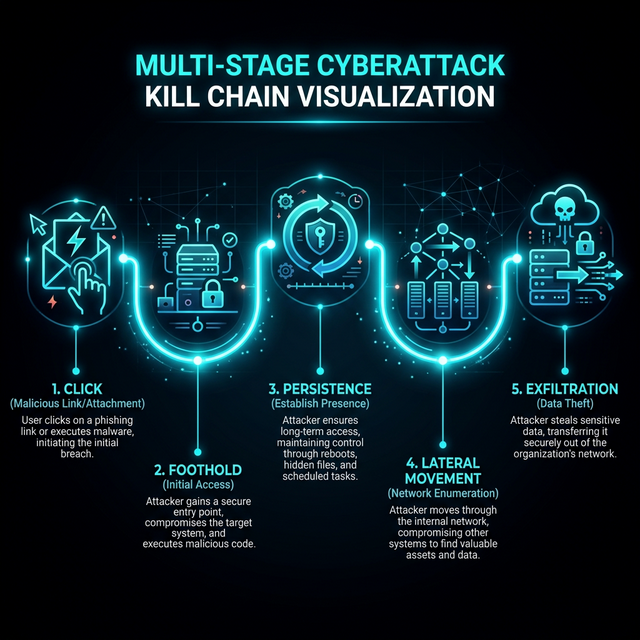
The Multi-Stage Compromise Chain
Stage 1 — Initial Foothold: Once a user clicks a malicious link, the browser is directed to an attacker-controlled site that exploits a browser vulnerability or tricks the user into downloading a "loader." In the ClickFix chain, malicious JavaScript injects a PowerShell command into the user's clipboard. The user, thinking they're following a security verification process, pastes and executes it manually.
Stage 2 — Persistence & C2: The malware modifies registry keys, creates scheduled tasks, or hides in legitimate-looking directories to survive reboots. It then beacons to Command-and-Control infrastructure, often leveraging legitimate cloud services like GitHub or OneDrive to blend with normal traffic ("living off the land").
Stage 3 — Lateral Movement: The attacker moves "sideways" through the network using credential harvesting (Mimikatz), Pass-the-Hash authentication, and abuse of legitimate tools like PowerShell Remoting, WMI, or RDP.
Stage 4 — Exfiltration: Data — intellectual property, customer PII, financial records — is exfiltrated to remote locations. In ransomware attacks, actors move laterally to maximum systems before triggering simultaneous encryption.
| Stage | Adversary Goal | Enterprise Impact |
|---|---|---|
| Initial Access | Gain foothold via URL | Single endpoint compromise |
| Persistence | Maintain long-term access | Dwell time begins (avg. 24–168 days) |
| Credential Theft | Escalate permissions | Potential admin takeover |
| Lateral Movement | Access high-value assets | Server environment contamination |
| Exfiltration | Steal sensitive data | Regulatory fines / reputational damage |
| Impact | Encrypt/destroy data | Operational paralysis / ransom demands |
Session Hijacking and MFA Bypass
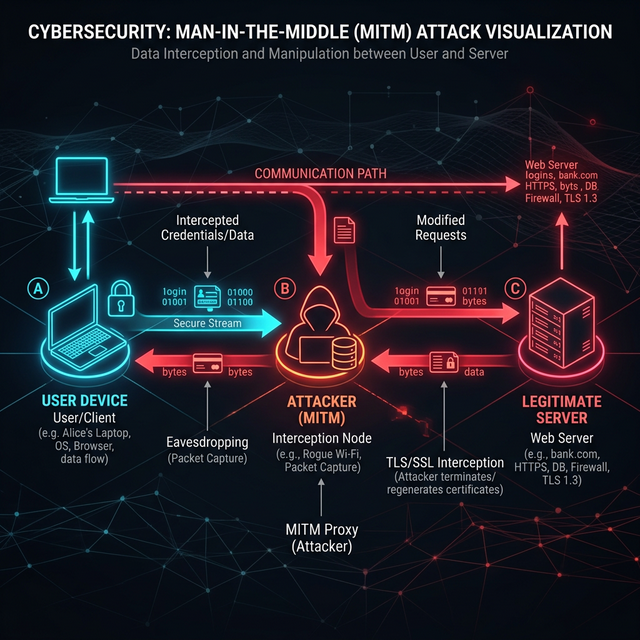
The widespread adoption of Multi-Factor Authentication (MFA) has forced attackers to develop more sophisticated methods. Malicious URLs are now the primary vehicle for "Adversary-in-the-Middle" (AiTM) attacks that bypass MFA entirely.
When a user logs into a web service, the server issues a session token. If an attacker steals this token, they clone the user's "logged-in" state on their own machine, bypassing passwords and MFA codes entirely. In an AiTM attack, the malicious URL directs users to a proxy server sitting between them and the legitimate service. Credentials and MFA codes entered on the fake page are forwarded in real-time. Once authentication succeeds, the attacker intercepts the session cookie.
Tools like Evilginx have commoditized this technique, allowing even low-skilled attackers to launch sophisticated campaigns. The data reflects this: in 2024, 79% of detections were "malware-free" as attackers chose to "log in" with stolen tokens rather than "break in" with code exploits.
The Global Cost of a Data Breach
According to IBM's 2025 Cost of a Data Breach Report, the average cost of a breach in the United States has reached $10.22 million per incident. Phishing remains the most common initial attack vector, accounting for 16% of all breaches with an average cost of $4.8 million.
A significant contributor to rising costs is "Shadow AI" — the unsanctioned use of AI tools by employees. Breaches involving Shadow AI cost organizations $670,000 more than standard incidents. Meanwhile, 60% of all breaches involve the "human element," primarily through clicking malicious links. The median click rate on simulated phishing exercises remains at 1.5% — in a large organization, that represents hundreds of potential entry points.
| Industry | Avg. Breach Cost (2025) | Critical Risk Factor |
|---|---|---|
| Healthcare | $7.42 Million | Sensitive PII; life-safety impact |
| Finance | $6.08 Million | Direct monetary gain; regulatory fines |
| Manufacturing | $5.50 Million | IP theft; operational disruption |
| Retail | $4.20 Million | Mass customer data; brand loyalty |
Case Studies in Enterprise Failure
SolarWinds (2020): State-sponsored actors compromised the Orion software supply chain, injecting malicious code into updates distributed to thousands of government and corporate networks. Advanced lateral movement techniques maintained stealth by blending with legitimate traffic.
Colonial Pipeline (2021): The DarkSide ransomware group gained initial access through a single compromised VPN credential, moving laterally until they reached billing and IT infrastructure. The resulting ransomware deployment forced shutdown of operations, creating fuel shortages across the Eastern United States.
Interlock Ransomware (2024-2025): This group pioneered "user-led" infection chains using drive-by downloads from compromised websites disguised as browser updates. Users were persuaded to execute PowerShell code manually. Once inside, Remote Access Trojans established control, escalating privileges to paralyze hospital systems and manufacturing facilities.
Building a Multi-Layered Defense Strategy
Step 1 — Automated URL and File Triage: Tools like urlscanner.online should evaluate every inbound URL's reputation, infrastructure, and behavior before it reaches the user. Any file delivered via a link should be triaged through filescanner.online using PE/ELF header parsing and YARA rules to identify malicious intent even without known signatures.
Step 2 — Hardening Identity and Access: Move beyond SMS-based MFA toward phishing-resistant hardware keys (FIDO2/WebAuthn). Implement strict session timeouts and monitor for "impossible travel" — session tokens used from two distant locations in a short timeframe.
Step 3 — Network Segmentation: Implement granular Zero Trust access controls requiring continuous verification. Monitor and restrict outbound traffic to prevent C2 beaconing and data exfiltration.
Step 4 — Continuous Monitoring and Response: Stream log data into SIEM systems for real-time correlation. Utilize SOAR platforms to automatically terminate suspicious sessions or quarantine compromised devices the moment a threat is detected.
| Component | Function | Strategic Value |
|---|---|---|
| urlscanner.online | Real-time link vetting | Blocks malicious URLs at the gateway |
| filescanner.online | Deep structural file triage | Identifies zero-day payloads |
| FIDO2 Keys | Phishing-resistant MFA | Eliminates session hijacking risk |
| Micro-segmentation | Network isolation | Limits lateral movement potential |
| SOAR Workflows | Automated remediation | Reduces Mean Time to Respond (MTTR) |
The AI Arms Race: Future of URL Security
Attackers are now using Large Language Models to automate reconnaissance and generate phishing lures indistinguishable from legitimate communications — an 89% year-over-year jump in AI-enabled attacks. "Deepfake" vishing, where an executive's voice is cloned to authorize fraudulent transactions, represents a new frontier in social engineering.
To counter these threats, the next generation of security tools integrates AI at the core. urlscanner.online and filescanner.online represent this evolution, moving beyond static checks to behavioral and intent-based analysis. By using deep learning to recognize visual and structural patterns of phishing and malware, these tools provide defense at the same speed and scale as the attackers.
The compromise of an entire company following a single malicious URL click is not a failure of technology alone, but a failure of strategy. By leveraging specialized tools from Aprensec — filescanner.online for structural payload parsing and urlscanner.online for infrastructure analysis — organizations can implement a proactive defense that identifies threats at the moment of inception.
Download the full PDF report
Get the complete analysis with all citations, charts, and technical appendices. Enter your email below to receive the download link.