
 FileScanner.online
 URLScanner.online
Introduction: The Grandparent Trap in the Digital Age
The story usually starts the same way across thousands of households in Spain: my grandmother eagerly calls me on a Sunday afternoon to tell me about a "crazy investment opportunity" she just found. It promises incredible mathematical returns, practically guaranteed by an algorithm, and heavily features endorsements from famous Spanish celebrities, actors, or politicians who supposedly leaked the secret. The names change — sometimes it is Amancio Ortega, other times it is Pablo Motos or even the King himself — but the formula is always identical.
But the most alarming part is not the absurdity of the scam itself — it is the delivery mechanism. She found it on Google News. By simply swiping left on the home screen of her Android phone — a gesture that is embedded into the daily muscle memory of millions of users — she, like many others, is exposed to what appears to be a legitimate, curated news feed. Google Discover and Google News are implicitly trusted by the general public as gatekeepers of quality journalism. After all, if Google is showing it, it must be real, right?
Wrong. Mixed amongst real newspaper articles from established publications like El País, La Vanguardia, and El Mundo are highly sophisticated, deceptive advertisements and algorithmically-placed content designed to mimic real journalism. These links drive traffic to meticulously crafted fake news portals. Because they surface directly within a trusted Google ecosystem, the perceived legitimacy is sky-high. The user never even opens a browser — the content appears natively within an app they trust implicitly.
I always have to painstakingly explain to my grandmother that these are elaborate, multi-layered scams designed to steal her savings. And she is not alone. Across Spain, this is happening to millions of people of all ages, from retirees to young professionals. This article is an extensive, technical investigation into what these sites are actually doing, the infrastructure they rely on, how they systematically capture user data, the affiliate networks that profit from them, and the technical mechanisms they employ to stay hidden in plain sight from Google's own policies and from traditional security tools.
Why Google News? Understanding the Attack Surface
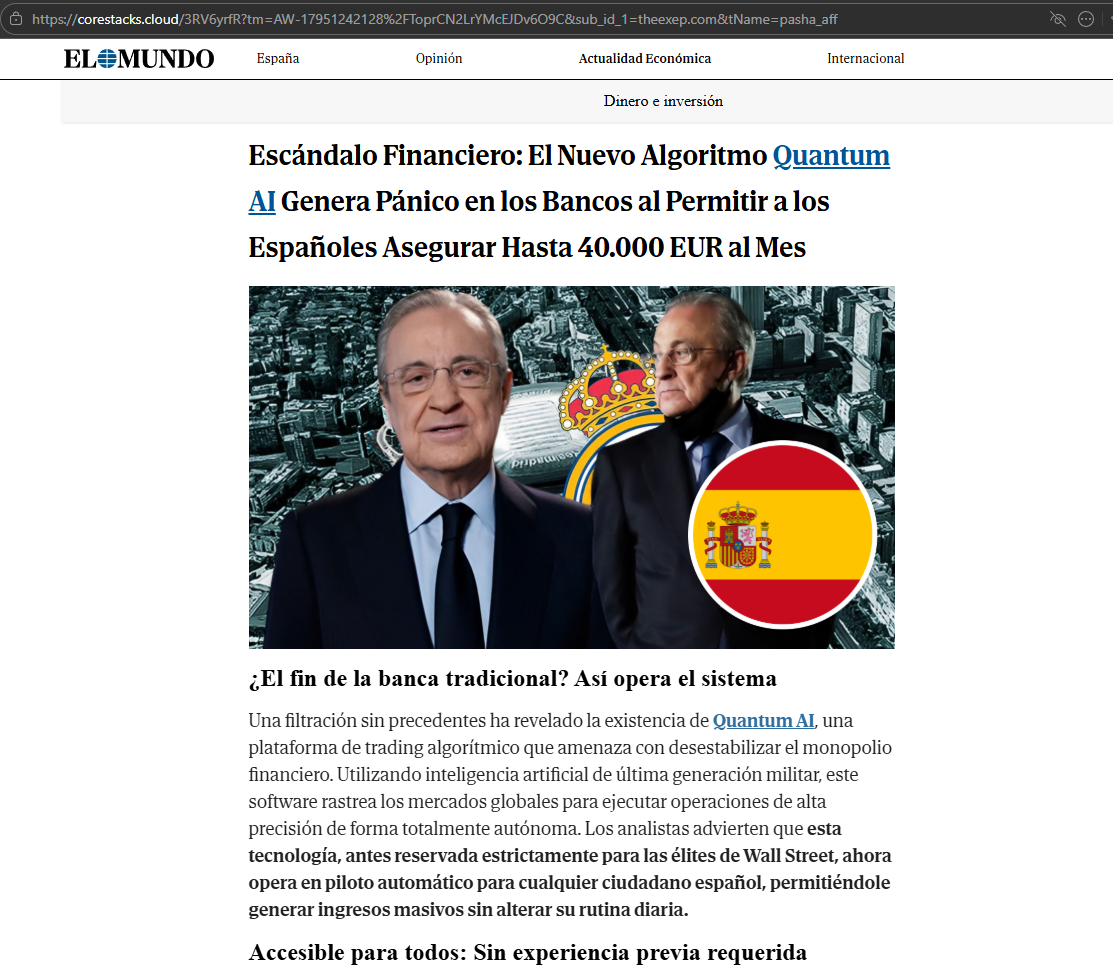
To understand why Google News has become the preferred attack surface for these scam campaigns, we need to understand how the platform works. On most Android devices, swiping left on the home screen opens Google Discover, a personalized content feed powered by machine learning algorithms. This feed aggregates content from thousands of publishers and presents it based on the user's interests, browsing history, and location.
The critical vulnerability here is not technical in the traditional sense — it is psychological. Google Discover does not display URLs prominently. The content appears in a card-based layout that visually equates a malicious ad with a legitimate news article from El Mundo or El País. Users do not have the visual cues they would normally use to assess trustworthiness, such as checking the address bar of a browser.
Furthermore, Google's advertising platform allows advertisers to purchase placements within the Discover feed. While Google has strict policies against deceptive advertising, the enforcement is reactive. Scam operators create throwaway accounts, run campaigns for a few hours or days, collect as many leads as possible, and then disappear before Google's moderation systems catch up. By the time the ad is flagged and removed, thousands of users have already clicked.
This creates a perpetual cat-and-mouse game where the scammers always have a structural advantage: the cost of creating a new campaign is negligible, while the cost of detecting and removing it is significant. The result is an endless stream of fake investment articles appearing in the news feeds of millions of Spanish Android users every single day.
Technical Analysis: corestacks.cloud Infrastructure
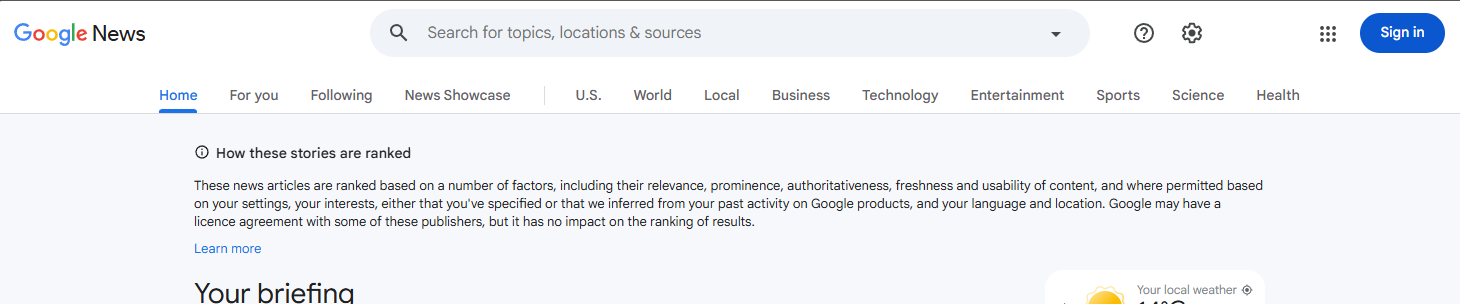
Following the redirect chain from the Google link, the user ultimately lands on https://corestacks.cloud/3RV6yrfR?tm=AW-17951242128&sub_id_1=theexep.com&tName=pasha_aff. This is where the real scam begins. Using our URL scanning and threat intelligence tools, we performed a comprehensive analysis of this domain.
The scan, completed in 29.1 seconds, revealed several critical indicators of compromise. The domain corestacks.cloud resolves to Cloudflare IP addresses 172.67.219.150 and 104.21.24.159, with IPv6 addresses 2606:4700:3033::ac43:db96 and 2606:4700:3034::6815:189f. The nameservers are the standard Cloudflare pair: nicolas.ns.cloudflare.com and adele.ns.cloudflare.com.
The technology stack detected includes Nginx as the web server (high confidence), Bootstrap as the CSS framework (medium confidence), and Tailwind CSS for additional styling. This is a classic "burner site" stack — cheap to deploy, fast to iterate, and trivially disposable.
Most critically, the domain was only 65 days old at the time of our scan. It uses the generic .cloud TLD, which is commonly abused because it is cheap and carries no inherent trust signals. Despite all these red flags, the domain was not listed in URLhaus, had no Google Safe Browsing data, was not listed on Spamhaus, and was not flagged by SURBL. In other words, every major threat intelligence feed considered this domain clean. This is a fundamental failure of signature-based detection against disposable infrastructure.
The Fraudulent Mirror: How They Clone El Mundo
The visual payload delivered by corestacks.cloud is a masterpiece of deception. It is a meticulously crafted, pixel-perfect clone of El Mundo, one of Spain's oldest and most recognized newspapers. Every element has been replicated with surgical precision: the masthead, the navigation bar, the article typography, the sidebar with "trending stories", and even the GDPR cookie consent popup.
An unsuspecting user — especially one who arrived via a trusted Google feed — would have absolutely no visual indication that they are not reading a real El Mundo article. The only tell is the URL in the browser's address bar, which shows corestacks.cloud instead of elmundo.es. But on mobile devices, the address bar is often minimized or hidden during scrolling, making even this last line of defense effectively invisible.
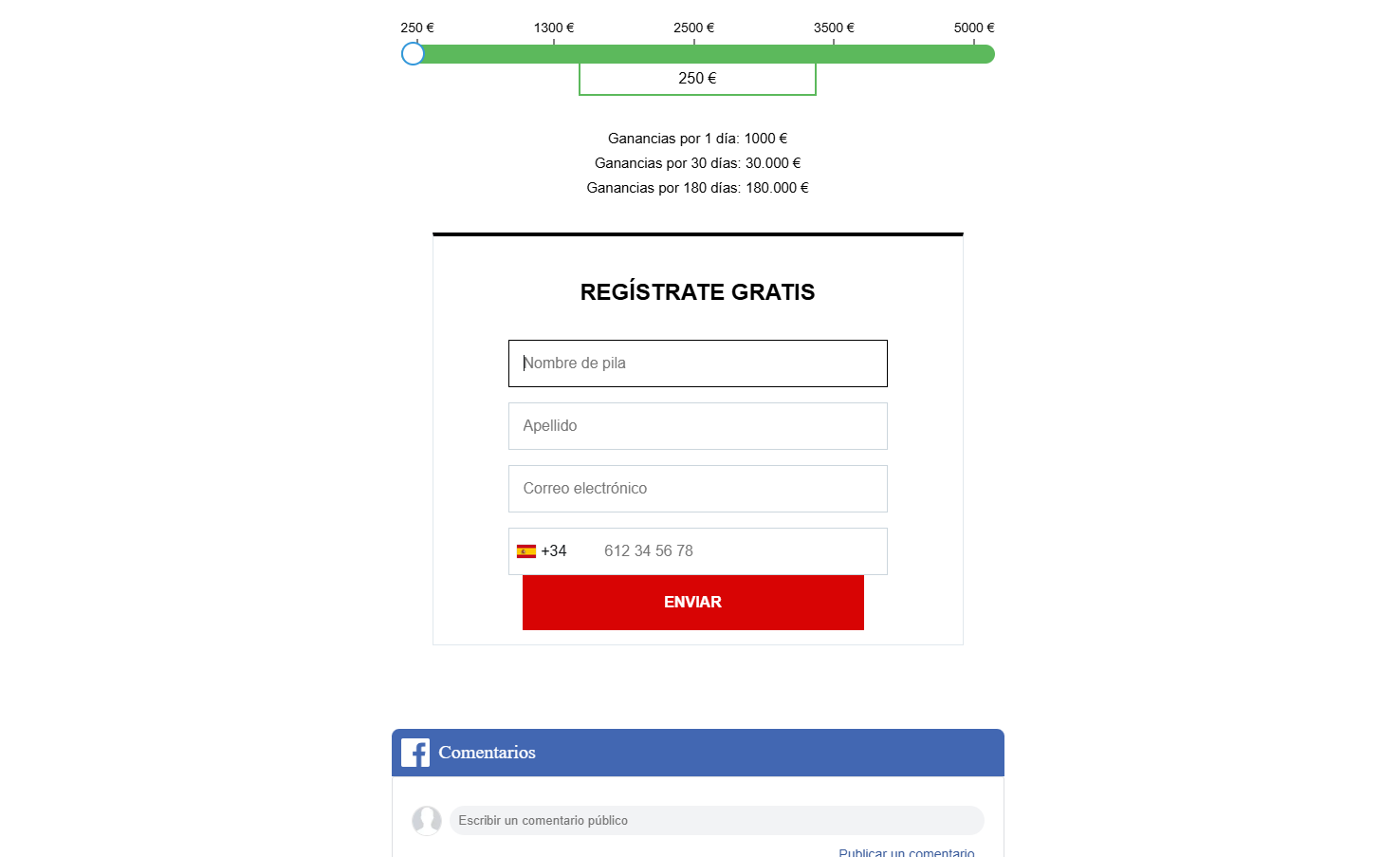
The fake article itself is a case study in social engineering. It typically frames a "breaking news" story about a Spanish celebrity — say Amancio Ortega or a popular TV host — who allegedly appeared on a live television show and accidentally revealed a "secret" investment loophole. The article breathlessly describes how the broadcast was "immediately cut" by the network, how "the banks are trying to suppress this information", and how a revolutionary AI-powered trading platform called "Quantum AI" can generate 1,000€ per day from a 250€ initial deposit.
The entire psychological framework is designed to exploit three cognitive biases simultaneously: authority bias (the celebrity endorsement), scarcity bias (the information is being "suppressed" and you must act now), and social proof (testimonials from other users who have supposedly made thousands of euros). It is devastatingly effective, particularly against older demographics who may not be familiar with these manipulation techniques.

The Registration Form: Where Data Becomes Currency
Embedded within the fake El Mundo article — and sometimes presented as a pop-up overlay — is the registration form. This is the critical conversion point in the scam funnel, the moment where a curious reader becomes a qualified lead for the criminal call centers.
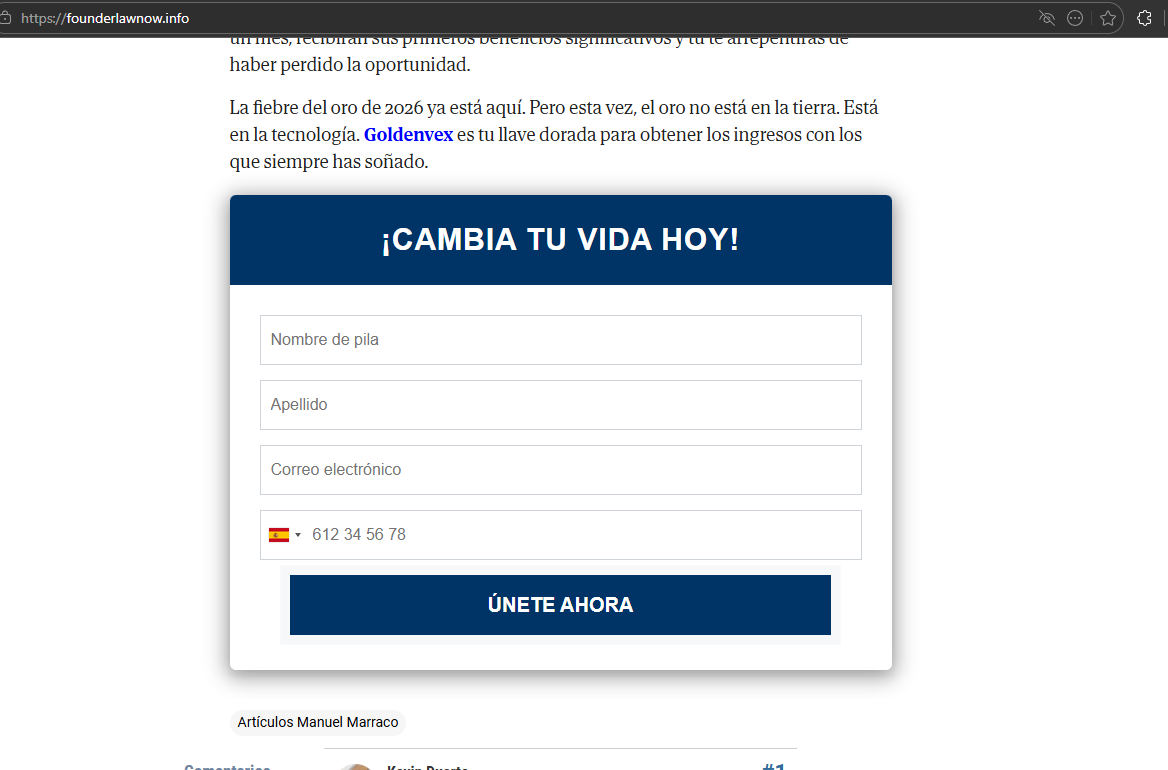
The form requests four pieces of information: first name, last name, email address, and phone number. The design is deliberately minimal and non-threatening. It mimics the registration forms of legitimate financial platforms, complete with reassuring text like "Your data is protected" and fake trust badges. Some variants even display a fabricated countdown timer: "Only 7 spots remaining for users in your area."
In this underground ecosystem, the phone number is the ultimate prize — the core commodity that drives the entire multi-million euro fraud machine. A verified, active Spanish mobile phone number belonging to an individual who has demonstrated interest in investing is worth between 50€ and 200€ on the affiliate market, depending on the quality of the lead and the current demand from call centers.
After the Form: The Thank You Page and What Happens Next
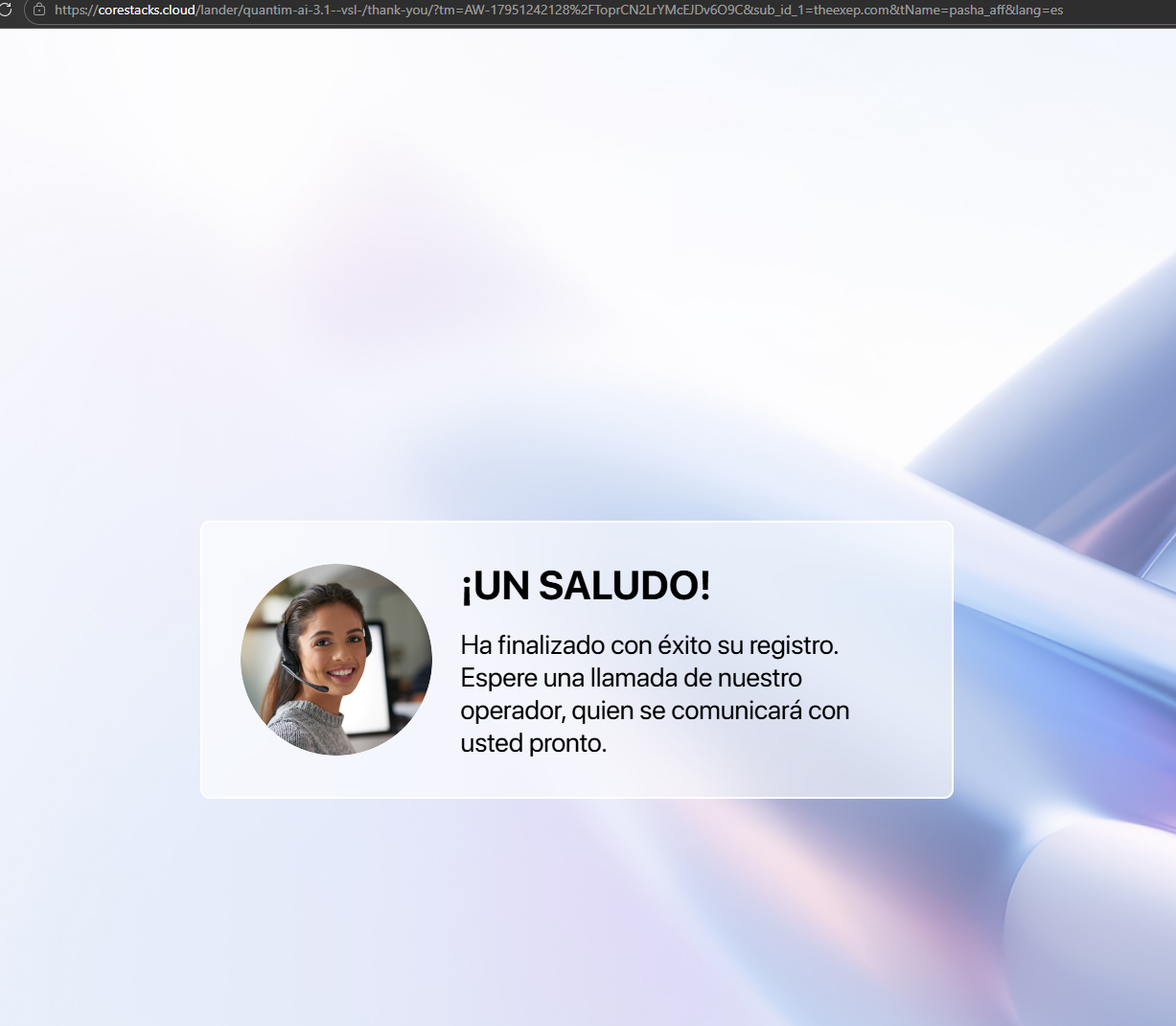
Submitting the form leads to a generic "Thank You" page at a path such as /lander/quantim-ai-3.1--vsl-/thank-you/?lang=es. Note the lang=es parameter — the system knows the victim is Spanish and will route accordingly.
This page completes the digital portion of the scam. The user sees a message confirming their "registration" and is told that a "specialist" will contact them shortly. What happens next is where the real financial damage begins.
Within hours — and often within minutes — the victim will receive a phone call from a highly trained "broker." These are not amateur scammers; they work from professional call centers, often located in countries outside EU jurisdiction such as Georgia, Albania, or Israel. They follow meticulously scripted playbooks designed by behavioral psychologists. The initial call is friendly and reassuring, building rapport and establishing trust.
The broker will guide the victim through creating an account on a fake trading platform (which is actually just a web dashboard showing fabricated profits). They will request an initial "seed deposit" of 250€ to 500€, often helping the victim process the payment via credit card or bank transfer in real-time. Once the money is deposited, the dashboard immediately shows impressive "returns" — sometimes doubling or tripling the investment within hours.
This is, of course, entirely fabricated. The dashboard is a simple web application displaying randomized upward-trending numbers. But the victim, seeing their "investment" grow, is psychologically primed to deposit more. The broker will call repeatedly, sometimes daily, pressuring the victim to increase their investment. When the victim eventually tries to withdraw their "profits", they are told they need to pay a "withdrawal fee" or a "tax deposit" — yet another layer of extortion. In many documented cases across Spain, victims have lost their entire life savings, sometimes exceeding 50,000€ or more.
Campaign #2: Intercepting founderlawnow.info
To build a more complete picture of the affiliate network infrastructure, we analyzed a second, independent campaign. This one originated from a different Google link format: https://search.app/F7mex, which redirected to https://founderlawnow.info/.
The search.app domain is another Google-owned property used for sharing content from the Google app. Like share.google, it provides the scammers with an authoritative redirect shield that is virtually impossible for traditional security tools to block.
Our analysis of founderlawnow.info revealed a strikingly similar infrastructure profile. The domain sits behind Cloudflare (IPs 104.21.85.102 and 172.67.204.115), runs PHP 8.3.30 on the backend, and uses Bootstrap for the frontend. The TLS certificate was issued by Google Trust Services (WE1), valid from February 13 to May 14, 2026 — a short-lived certificate typical of disposable scam infrastructure.
The HTTP response headers revealed several telling details. The cache-control: no-store, no-cache, must-revalidate directive ensures that each visit generates a fresh response — likely to enable server-side A/B testing and to prevent cached versions from being analyzed. The cf-ray header (9db53d7549790362-MAD) confirms the request was served from Cloudflare's Madrid PoP, indicating the campaign is specifically geo-targeting Spanish users.
Just like corestacks.cloud, this domain passed all major threat intelligence checks clean: not listed in URLhaus, no Google Safe Browsing flags, not on Spamhaus, not on SURBL. The attackers understand exactly which reputation databases security tools rely on, and they ensure their infrastructure stays below the detection threshold.

Going Undercover: Submitting a Fake Lead
To trap the system and reverse-engineer the backend, we adopted the identity of the victim. We submitted a carefully crafted dummy request through the founderlawnow.info contact form, using the fictitious identity "Joselito Caradura" (a name that roughly translates to "Joey Shameless" in Spanish — a small inside joke for our research team).
The dummy lead details were: name Joselito Caradura, email [email protected], and phone number +34612783920. We configured a network proxy to intercept and capture all outbound HTTP traffic from the browser during the form submission process.
The form submission triggered an HTTP POST request to https://founderlawnow.info/sdk/ — the backend API endpoint responsible for processing leads. The intercepted payload was a treasure trove of intelligence, containing not only the victim's personal data but also an extensive set of affiliate tracking parameters that expose the entire business model behind these scam campaigns.
The Smoking Gun: Decoding the Affiliate Telemetry
The intercepted HTTP POST request was a goldmine of threat intelligence. Beyond the lead's personal data, the payload contained over 20 affiliate tracking parameters that lay bare the entire commercial structure of this criminal ecosystem:
action=push-lead&tp_aff_sub=[QA] founderlawnow.info - [4028] Goldenvex - Gold Rush - ES&tp_aff_sub2=weo76kb7o9ove3ug3fh2ct45&tp_aff_sub3=founderlawnow.info&tp_aff_sub10=01k|2333-152&tp_aff_sub11=goldenvex&tp_aff_sub16=Google_Discovery&tp_aff_sub20=founderlawnow.info
Let us decode the most significant parameters. The action=push-lead field explicitly names the operation: this is a system designed to "push" captured leads to downstream buyers. The tp_aff_sub main parameter reveals the full campaign descriptor: "[QA] founderlawnow.info - [4028] Goldenvex - Gold Rush - ES". This tells us the quality assurance tag ([QA]), the landing page domain, the campaign ID ([4028]), the affiliate network name ("Goldenvex"), the campaign creative name ("Gold Rush"), and the target market (ES = Spain).
The parameter tp_aff_sub11=goldenvex identifies the specific affiliate team or network responsible for driving traffic. tp_aff_sub16=Google_Discovery is the smoking gun — it proves that the affiliates are explicitly tracking their traffic source as Google Discovery, confirming that the exploitation of Google's content feed is not accidental but a deliberate, targeted strategy.
Finally, the s=eyJwIjpmYWxzZSwiZCI6ZmFsc2V9 parameter is a Base64-encoded JSON payload. Decoding it yields {"p":false,"d":false}, which likely represents internal flags for the lead (possibly "premium" and "duplicate" status).
This data conclusively demonstrates that these campaigns are not isolated operations run by a single criminal entity. They are products of a decentralized Cost Per Action (CPA) affiliate marketplace where traffic affiliates, landing page operators, lead aggregators, and call centers each play a specialized role in an industrialized fraud supply chain.
The API Error That Exposed Everything
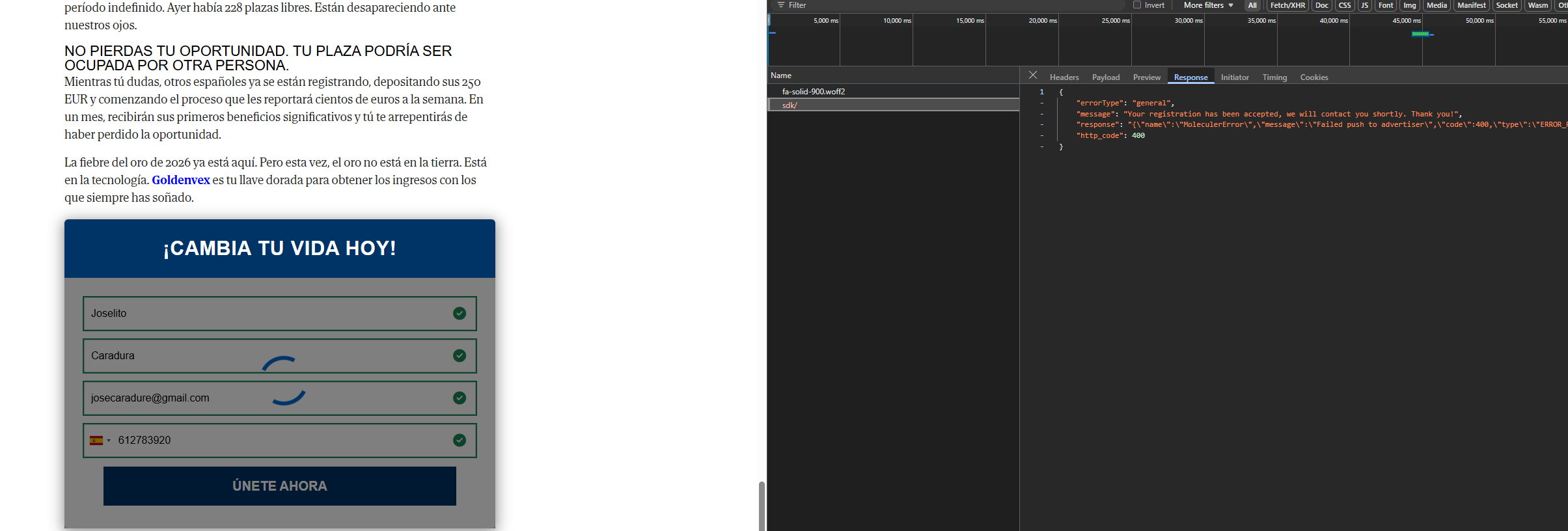
Perhaps the most revealing moment in our investigation came not from what worked correctly, but from what broke. Because our submitted data was intentionally fabricated with a non-functional phone number, the scam's backend API returned a verbose error response that the developers had neglected to sanitize for production:
{"errorType":"general","message":"Your registration has been accepted, we will contact you shortly. Thank you!","response":"{"name":"MoleculerError","message":"Failed push to advertiser","code":400,"type":"ERROR_PUSH","data":{"lead_uuid":"46d4f882-a120-4b9e-88df-770c2dbf4b30","errorMessage":"[CLIENT: 320] Rotation rules for this lead weren’t found. Please, check Rotation Control.","errorType":"ROTATION_ERROR"}}","http_code":400}
This leaked error response is extraordinary in the amount of architectural intelligence it reveals. First, note the deliberate deception at the surface level: the user-facing message field says "Your registration has been accepted" — the victim would never know their submission had failed. The real error is buried in the response field, which was clearly meant for internal debugging only.
The backend framework is identified as Moleculer, a popular Node.js microservices framework. This tells us the scam infrastructure is built on a modern, scalable microservices architecture — not a simple PHP script, but a professionally engineered system designed to handle high volumes of leads across multiple campaigns and markets simultaneously.
The error type ERROR_PUSH and message "Failed push to advertiser" confirms the real-time lead distribution model. When a user submits the form, the system immediately attempts to "push" (sell) that lead to a connected call center — the "advertiser" in affiliate marketing terminology.
The critical phrase "[CLIENT: 320] Rotation rules for this lead weren't found. Please, check Rotation Control" reveals the existence of a sophisticated lead rotation system. This is a real-time auction mechanism that routes leads to call centers based on configurable rules: the victim's country code (+34 for Spain), the time of day, the quality score of the lead, the current capacity of each call center, and which advertiser is offering the highest payout. Our dummy lead with its fabricated phone number simply didn't match any active buyer profile in the rotation matrix, causing the system to reject the push.
The lead_uuid field (46d4f882-a120-4b9e-88df-770c2dbf4b30) demonstrates that each captured lead is assigned a unique identifier for tracking across the entire supply chain — from affiliate to aggregator to call center. This level of infrastructure sophistication is consistent with organized cybercrime operations generating millions of euros in annual revenue.
The Scale of the Problem: Why Traditional Defenses Fail
One of the most concerning aspects of this investigation is the systematic failure of every traditional security mechanism. Let us enumerate the defenses that were bypassed in both campaigns we analyzed:
Google Safe Browsing: No data or no threats found for either domain. Google's own threat detection system — the same one that protects Chrome users worldwide — did not flag these sites.
URLhaus: Not listed. The abuse.ch database, which tracks malware distribution URLs, had no records for either domain.
Spamhaus: Not listed. One of the oldest and most comprehensive blocklists in the world had no data on these IPs.
SURBL: Not listed. The spam URI real-time blocklists used by email security gateways had no records.
VirusTotal: Clean results from the majority of scanning engines across both domains.
This is not a failure of these individual systems — they are excellent at what they do. It is a fundamental architectural mismatch. These threat intelligence databases are designed to detect malware distribution, botnet command and control, and known phishing kits. Investment scam landing pages that use clean HTML, no malware payloads, and disposable domains simply do not trigger the detection heuristics these systems rely on.
The scam operators know this intimately. They operate within the "gray zone" between clearly malicious content (which would be detected) and legitimate advertising (which is allowed). Their domains are too new to have reputation data, their content contains no malicious code, and their infrastructure uses mainstream services like Cloudflare that cannot be broadly blocked without massive collateral damage.
This is precisely why behavioral URL analysis tools are essential. URLScanner.online can detect these scam sites by analyzing the rendered page content, technology stack, and domain age — not just checking reputation databases. Combined with FileScanner.online for analyzing any downloaded files or attachments, these tools provide the deeper layer of inspection that traditional feeds cannot.
Conclusion: Protecting Yourself and Your Family
The investment scams appearing in the Google News feeds of the Spanish public are not isolated, petty crimes. They are components of a highly industrialized, multi-million euro fraud ecosystem powered by ruthless affiliate networks, professional call centers, and sophisticated technology platforms built on modern microservices architectures. By exploiting native application intents like share.google and search.app, they effectively bypass every traditional web filter and security tool, slipping directly into the everyday trust circles of vulnerable users.
Based on our investigation, here are concrete steps you can take to protect yourself and your family:
1. Be skeptical of financial content in Google News. Treat any article about investment opportunities, algorithmic trading, or celebrity-endorsed financial platforms with extreme suspicion, regardless of how legitimate the news source appears. Real newspapers do not promote specific trading platforms.
2. Always check the URL. Before engaging with any content, tap the address bar and verify you are on the legitimate domain (e.g., elmundo.es, not corestacks.cloud). If the domain looks unfamiliar, close the page immediately.
3. Never share your phone number. No legitimate investment platform will cold-call you. If a website asks for your phone number in exchange for "exclusive access" to a financial product, it is almost certainly a scam.
4. Use URL scanning tools. If you receive a suspicious link, submit it to URLScanner.online or FileScanner.online before clicking. These free tools can follow redirect chains, analyze the final destination page, and cross-reference against multiple threat intelligence databases — exactly as we did in this investigation.
5. Talk to your family. The most effective defense against these scams is awareness. Share this article with your parents, grandparents, and anyone who uses a smartphone. Explain that Google News can contain scam ads and that a trusted app does not guarantee the safety of its contents.
6. Report scam ads. If you encounter a fraudulent ad in Google News or Google Discover, tap the three dots on the card and select "Report ad." While enforcement is imperfect, every report helps Google's algorithms learn to identify and remove these campaigns faster.
The fight against these industrialized scam networks requires a combination of advanced automated analysis, regulatory pressure on platforms, and — most importantly — continuous education. We must remind ourselves and our loved ones that in the digital age, trust must be earned, not assumed. The fact that content appears within a Google product does not make it true, safe, or real.